Why G-Shock is the Ultimate 'God-Tier' Watch for Every Collector
Discover why the Casio G-Shock transcends traditional horology to achieve 'God-Tier' status among elite watch collectors and everyday enthusiasts alike.

Mar 11, 2026 - Written by: Linda Wise
Open almost any elite watch collector’s safe, and you will witness a fascinating paradox. Nestled comfortably between the hand-finished platinum complications of A. Lange & Söhne and the unobtainable steel sports models of Audemars Piguet sits a chunky, unapologetic slab of Japanese resin.
It is the great equalizer of the horological world.
The Casio G-Shock defies every conventional metric we use to evaluate luxury timepieces. It lacks a mechanical heartbeat. It eschews precious metals in favor of urethane and carbon fiber. Its finishing is mass-produced rather than painstakingly applied by a Swiss artisan wielding a microscopic polishing wheel. Yet, the watch community has collectively bestowed upon it a title reserved for absolute perfection: “God-Tier.”
I’ve personally found that understanding why this $50-to-$5,000 tool watch commands such universal reverence requires peeling back the layers of its engineering, its cultural dominance, and its psychological grip on the collecting community.
Before we dissect the anatomy of this indestructible icon, let’s establish a baseline. If you are looking to immediately anchor your collection with the foundational pillars of the G-Shock family, here are the absolute essentials.
Quick Comparison: Top Picks
| Product | Rating | Check Price |
|---|---|---|
| Casio G-Shock DW5600E-1V | ⭐⭐⭐⭐⭐ | View on Amazon |
| Casio G-Shock GA2100-1A1 ‘CasiOak’ | ⭐⭐⭐⭐½ | View on Amazon |
| Casio G-Shock GW-M5610U-1CJF | ⭐⭐⭐⭐⭐ | View on Amazon |
The Genesis of Utilitarian Perfection
You cannot grasp the modern phenomenon of the G-Shock without intimately understanding its origin. The story is a masterclass in obsessive problem-solving.
In 1981, Casio’s head of watch design, Kikuo Ibe, accidentally dropped a pocket watch given to him by his father. It shattered upon hitting the floor. At that time, watches were inherently fragile instruments. You babied them. You took them off before doing anything remotely physically demanding. Ibe decided this paradigm was unacceptable.
He formed “Project Team Tough,” a three-man task force with a singular, seemingly impossible mandate: create an unbreakable watch. They established the “Triple 10” criteria. The watch had to survive a 10-meter drop, boast 10 bar (100 meters) of water resistance, and possess a 10-year battery life.
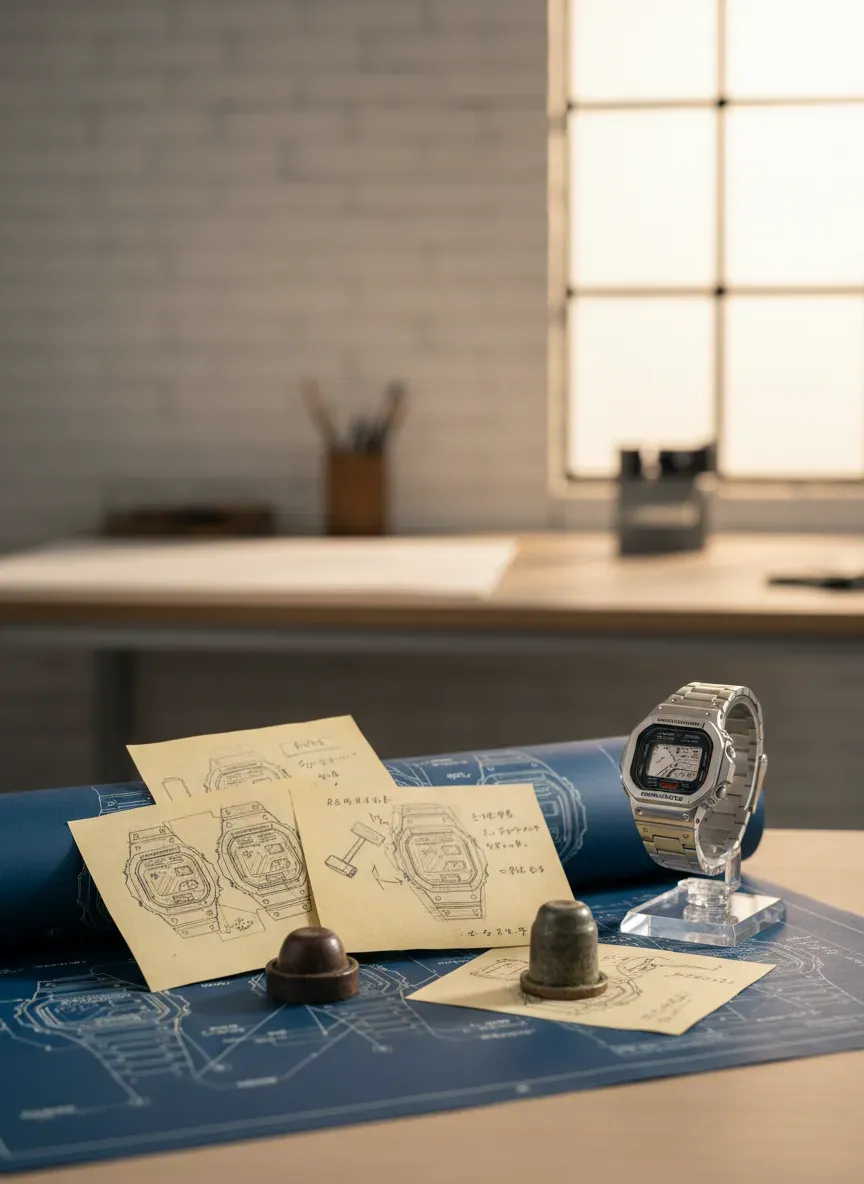
Over the next two years, Ibe’s team destroyed more than 200 prototypes. They literally threw watches out of a third-story bathroom window at Casio’s R&D center in Tokyo. Every single time, the quartz oscillator or the LCD screen shattered. The breakthrough came to Ibe in a moment of sheer serendipity while watching a child bounce a rubber ball in a park. He realized that the center of the ball suffered zero shock impact.
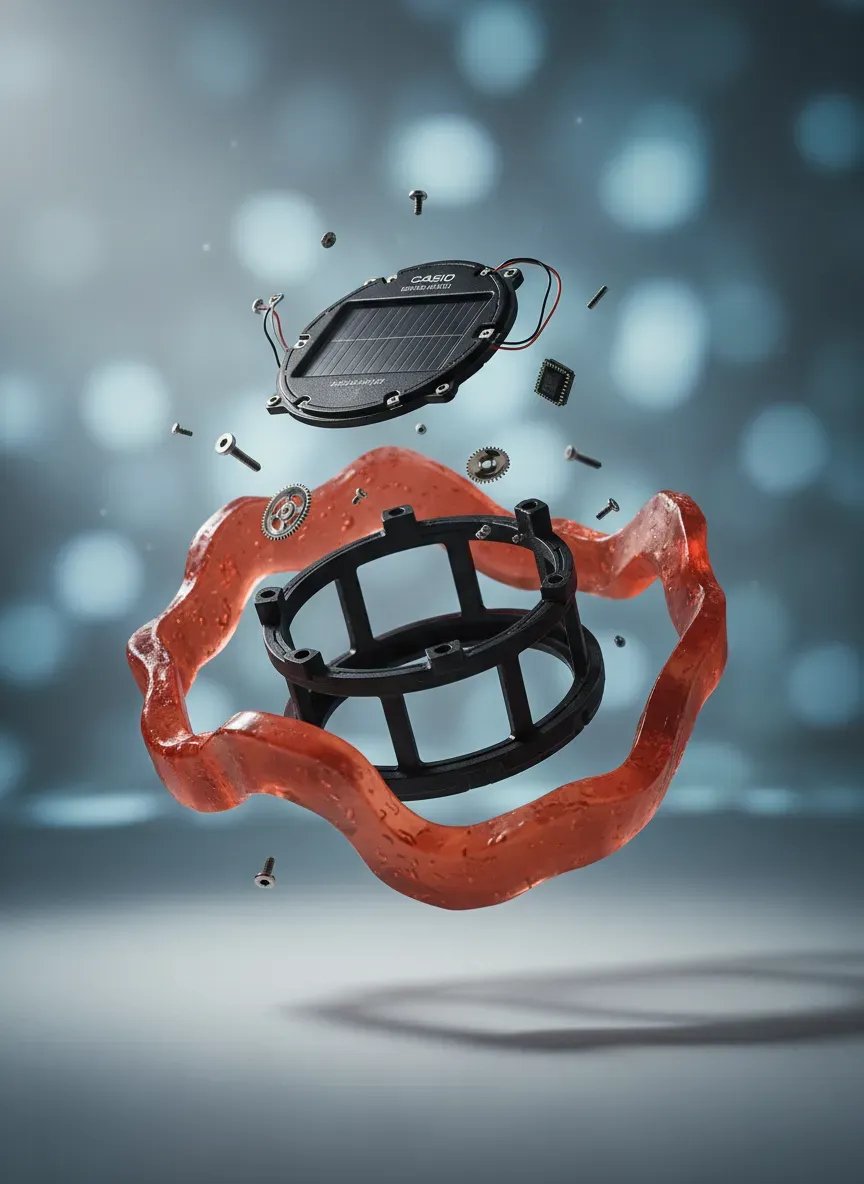
This revelation birthed the hollow-core case structure. Inside every G-Shock, the quartz module floats. It is supported at only a few critical points, suspended within a hollow chamber. A rugged urethane bezel acts as a protective bumper, protruding past the crystal and the buttons so that no matter what angle the watch falls, the impact is absorbed by the armor, not the delicate electronics.
The DW-5000C launched in 1983. It didn’t just meet the Triple 10 criteria; it obliterated it. Casio had accidentally created the blueprint for the most resilient wearable object in human history.
Deconstructing the “God-Tier” Moniker
The phrase “God-Tier” gained massive traction in recent years, largely popularized by high-profile watch dealers and YouTube personalities who found humor—and deep truth—in elevating a plastic Casio above haute horlogerie. But the meme only works because it is rooted in objective reality.
Watch snobbery is usually driven by exclusivity, price tags, and in-house mechanical movements. The G-Shock bypasses this entirely by excelling in an entirely different category: absolute utility. It is so good at being a watch that it transcends the need for luxury validation. If you’re currently browsing a comprehensive guide to finding the perfect present for a watch enthusiast, nothing hits the mark quite like a G-Shock. It is the one timepiece you can gift to a billionaire or a high school student and receive the exact same level of genuine appreciation.
The Anti-Fragile Philosophy
Most luxury watches are merely durable. A modern Rolex Submariner is built like a tank relative to other mechanical watches, but it still relies on hundreds of tiny metal pinions, gears, and springs that absolutely loathe kinetic shock.
A G-Shock is anti-fragile. It thrives under abuse. You wouldn’t dare strap a delicate mid-century timepiece to your wrist while firing an automatic rifle, operating a jackhammer, or plunging into a freezing kelp forest. A G-Shock begs for that exact treatment.
The military adoption of the G-Shock wasn’t the result of a massive government contract or a clever marketing campaign. It happened organically on the wrists of Navy SEALs, Special Forces operators, and first responders who went to the PX, spent their own money on a DW5600, and realized it was the only piece of gear that never failed them in the field. This authentic heritage of extreme performance is a pedigree that Swiss brands spend tens of millions of dollars trying to fabricate. Casio earned it by simply existing.
Three Heavyweights: Finding Your Perfect Casio
When you decide to add a G-Shock to your watch box, the sheer volume of references can be paralyzing. Casio releases thousands of variations. To cut through the noise, you need to look at the three archetypes that define the brand’s modern catalog.
The Purist’s Choice: DW5600
If you want the purest, most unadulterated distillation of Kikuo Ibe’s original vision, the Casio G-Shock DW5600E-1V is the undisputed champion.
This is the direct descendant of the 1983 original. It features the iconic octagonal “square” design, a basic but bulletproof Module 3229 (or the updated 3489), a stopwatch, a countdown timer, a multifunction alarm, and the famous electro-luminescent (EL) backlight that glows a satisfying, nostalgic blue-green.
At a price point that barely registers on a collector’s radar, it represents the highest ratio of horological significance to dollar spent in the entire industry. I’ve battered my personal DW5600 against coral reefs, dropped it off ladders, and subjected it to the blistering heat of a desert dashboard. It simply shrugs, beeps on the hour, and keeps perfect time.
The Hype Machine: GA2100 “CasiOak”
In 2019, Casio released a watch that unexpectedly broke the internet. The Casio G-Shock GA2100-1A1 took the DNA of the original square and morphed it into a sleek, analog-digital hybrid featuring an octagonal bezel.
The watch world immediately noticed its geometric resemblance to the legendary Audemars Piguet Royal Oak, affectionately dubbing it the “CasiOak.” But writing it off as a mere homage ignores the brilliant engineering inside. The GA2100 utilizes Casio’s Carbon Core Guard structure. By embedding carbon fiber into the fine resin case, Casio managed to make the watch incredibly rigid while reducing its thickness to a mere 11.8mm. It slides under a shirt cuff with ease, a rarity for the notoriously chunky G-Shock family.
The blackout version (1A1) became a modern classic overnight, proving that G-Shock could iterate on its rugged identity to produce something genuinely sleek and streetwear-compatible.
The Tech-Forward Daily: GW-M5610U
For the collector who demands “set it and forget it” perfection, the Casio G-Shock GW-M5610U-1CJF represents the ultimate evolutionary endpoint of the square platform.
Visually, it pays homage to the original DW-5000C with its red perimeter line and brick-pattern face. Internally, it is a technological marvel. The “U” designation marks the updated module featuring Tough Solar power and Multi-Band 6 atomic timekeeping.
- Tough Solar: Tiny solar panels seamlessly integrated into the dial harvest energy from both sunlight and artificial fluorescent light, charging a secondary battery. You effectively never need to change a battery again.
- Multi-Band 6: Every night at midnight, the watch automatically receives a radio signal from one of six atomic clock transmission stations located around the globe (in the US, UK, Germany, China, and two in Japan). It calibrates itself to the exact millisecond.
It is a watch that is perpetually powered and perpetually accurate. In a hobby obsessed with mechanical inaccuracy, there is something deeply satisfying about strapping on a watch that you know is correct down to the atomic level.
Advanced Collecting: Beyond the Basic Resin
Once you experience the gateway drug of the entry-level models, the G-Shock rabbit hole deepens rapidly. Casio engineers are notoriously relentless tinkerers, and they have pushed the boundaries of material science in their high-end collections.
The Master of G Series
If the standard G-Shock is a foot soldier, the Master of G line represents the Special Operations Command. These watches are engineered for specific, brutal environments.
The Frogman is the only G-Shock to feature ISO 6425 certification, making it a true, legally defined dive watch. Its iconic asymmetrical case design ensures that the watch doesn’t dig into the back of the diver’s hand when their wrist is bent backward during a swim. It features a full stainless steel (or titanium) inner case with a screw-down case back, heavy-duty dive logs, and in recent iterations, depth gauges and sapphire crystals.
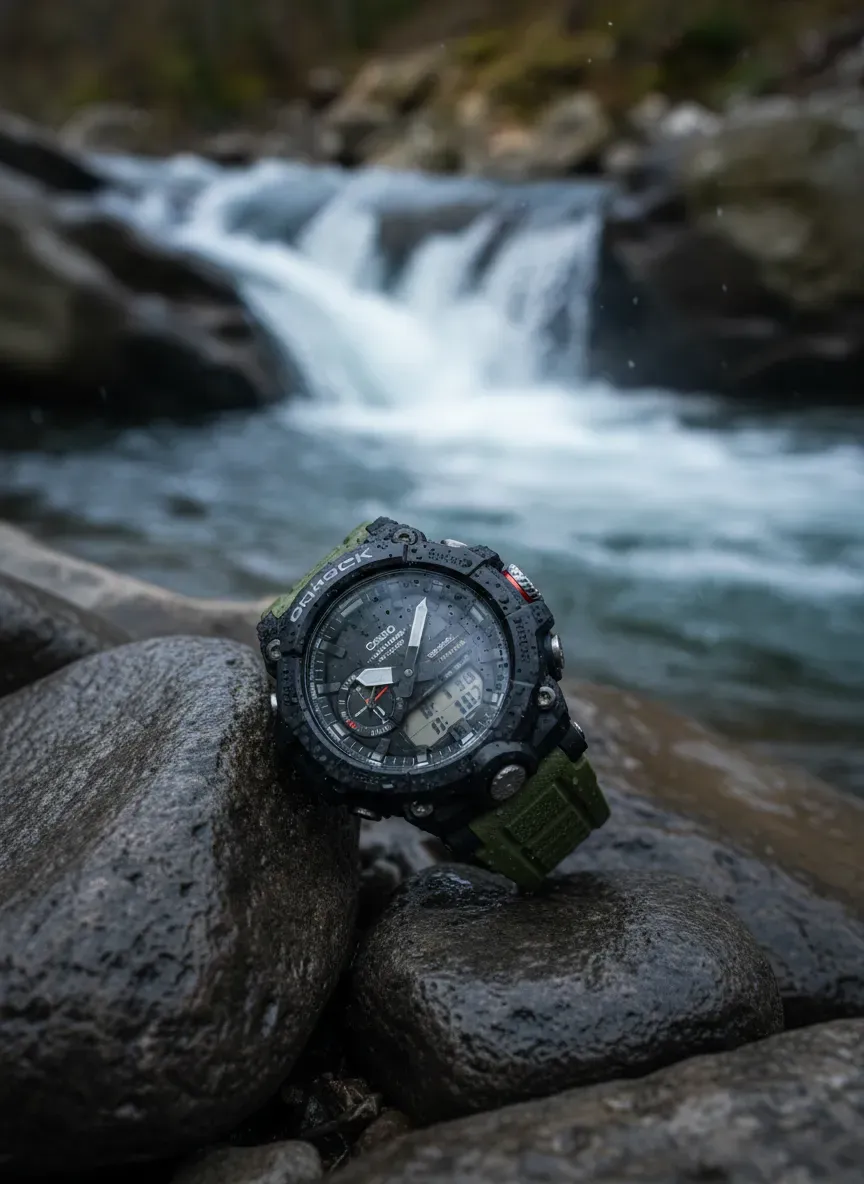
The Mudmaster was built for terrestrial hell. Its buttons utilize a proprietary series of cylindrical guard pipes and multiple O-ring gaskets to ensure that fine particulate matter—dust, silt, and heavy mud—cannot penetrate the case. It is massive, unapologetic, and features the “Triple Sensor” (altimeter/barometer, compass, and thermometer), turning it into a wrist-mounted weather station.
The Haute Horlogerie of Casio: MR-G and MT-G
This is where traditional watch snobs usually have their minds blown. Casio’s premium lines, the MT-G (Metal Twisted G-Shock) and MR-G (Majesty Reality G-Shock), command prices ranging from $1,000 to over $8,000.
These pieces are assembled by Casio’s master craftspeople at the Premium Production Line in Yamagata, Japan. The MR-G models replace the resin entirely with high-end titanium alloys like Cobarion (which is four times harder than pure titanium and shines like platinum). They utilize Zaratsu polishing—the exact same distortion-free, mirror-finishing technique used by Grand Seiko.
They integrate Bluetooth connectivity alongside GPS time-syncing, ensuring accuracy anywhere on the surface of the earth, even outside the range of Multi-Band 6 radio towers. To hold an MR-G is to hold a collision of brutalist 1980s design and ultra-modern Japanese artisanal metallurgy.
Pro Tip for Advanced Collectors: Pay close attention to the JDM (Japanese Domestic Market) models. Casio frequently reserves their most intriguing colorways, premium packaging, and carbon-fiber inserted straps strictly for the Japanese market. Sourcing a JDM reference adds an extra layer of exclusivity to your collection.
How G-Shock Fits into the Greater Horological Zeitgeist
The most fascinating aspect of the G-Shock is how it interacts with the rest of the watch market. It does not compete; it complements.
A well-rounded watch collection is essentially an exercise in balancing aesthetics, engineering, and purpose. While enthusiasts endlessly debate the nuances of Swiss luxury heavyweights, arguing over the finishing of an escapement or the heritage of a particular diver, the G-Shock sits quietly above the fray. It holds a permanent, unquestioned slot in the “two-watch collection” theory.
You can own a stunning Vacheron Constantin Overseas for the boardroom, the gala, and the fine dining experience. But when Saturday morning arrives—when you are changing the oil in your car, hiking a rugged trail, or wrestling with your kids in the pool—the Vacheron goes in the safe, and the G-Shock goes on the wrist.
It prevents the anxiety of ownership. Luxury watches bring joy, but they also bring an undeniable undercurrent of stress. You are constantly aware of door frames that might scratch your bezel, or magnetic fields from your laptop that might magnetize your hairspring. The G-Shock offers horological therapy. It provides a psychological release, allowing you to wear a genuinely respected timepiece without a micro-ounce of worry.
Common Pitfalls for New Collectors
Despite its flawless reputation, entering the world of G-Shock collecting does come with a few caveats. It is easy to get swept up in the massive catalog and make missteps. Here is what you need to navigate around:
- Ignoring Lug-to-Lug Realities: Casio’s dimensions can be incredibly deceiving. A watch listed with a 53mm case diameter sounds monstrous, but because many G-Shocks lack traditional lugs (the strap integrates directly into the underside of the case), they wear much smaller than the numbers suggest. Conversely, massive models like the Mudmaster GWG-2000 will hang off the edges of a smaller wrist. Always look at the lug-to-lug measurements, not just the case width.
- The Collab Trap: Casio collaborates with everyone—from streetwear giants like Kith and BAPE to musicians like John Mayer and Ed Sheeran. While these limited editions are undeniably cool, they are often just standard base modules stamped with a different colorway, sold at a massive markup on the secondary market. Buy collaborations because you deeply love the design, not because you think a plastic Casio is going to be a financial investment vehicle.
- Misunderstanding Resin Rot: While the internal modules of a G-Shock will outlive us all, the outer polyurethane armor has an Achilles’ heel: hydrolysis. Over the span of 15 to 20 years, prolonged exposure to sweat, UV rays, and moisture can cause the resin to become brittle and crumble—a phenomenon collectors call “resin rot.” The good news? The bezels and straps are easily and cheaply replaceable, acting as sacrificial armor that you simply swap out once a decade.
- Battery Degradation in Older Solar Models: If you buy a vintage Tough Solar model from the early 2000s, be aware that the rechargeable capacitor (essentially the battery) has a lifespan. If the watch was left in a dark drawer for five years, that capacitor might be dead and incapable of holding a charge, requiring a replacement that is slightly more complex than a standard battery swap.
Key Takeaways for the Aspiring God-Tier Owner
- Start with a Square: The 5600 series is the undisputed foundational text of G-Shock history.
- Embrace the Scratches: A pristine G-Shock is a tragedy. These watches are meant to document your life’s adventures through their battle scars.
- Look for Multi-Band 6 and Tough Solar: These two technologies transform a great digital watch into an autonomous timekeeping companion.
- Don’t Fear the Mods: The G-Shock community thrives on modification. Upgrading a standard GA2100 with an aftermarket stainless steel case and bracelet is a celebrated rite of passage.
The Bottom Line
True luxury is the absence of compromise. By that strict definition, the Casio G-Shock might be the ultimate luxury watch.
It never asks you to compromise your lifestyle to accommodate its fragility. It never demands thousands of dollars in routine servicing. It never loses a second of time if you sync it to the atomic clock. Kikuo Ibe set out to build an unbreakable watch, but in the process, he forged an unbreakable legacy.
Whether you are an aspiring enthusiast buying your very first timepiece or a seasoned veteran with a safe full of Swiss horological royalty, the G-Shock demands a place on your wrist. It is not just a watch; it is a testament to the power of pure, unapologetic utility. And that is exactly why it will forever reign as God-Tier.