Limited Edition G-Shocks: The Must-Have Models This Season
Discover this season's most coveted limited edition G-Shocks. A collector's deep dive into titanium metallurgy, investment geometry, and hyper-rare Casio releases.

Mar 11, 2026 - Written by: Linda Wise
You hear the name “G-Shock” and your mind immediately jumps to a specific aesthetic. Thick resin. Utilitarian geometry. The kind of watch you strap on when you are framing a house, running a tactical course, or simply avoiding the anxiety of scratching a five-figure mechanical piece. But if you have been paying attention to the horological undercurrents over the last few years, you know the narrative has violently shifted.
Casio has quietly engineered a backdoor into the high-end luxury market.
I’ve personally found that explaining the appeal of a $4,000 digital watch to a traditionalist usually results in raised eyebrows. They don’t understand the mastery happening inside the Yamagata factory’s Premium Production Line (PPL). They haven’t handled the Cobarion alloys, witnessed the vapor deposition techniques, or felt the cold, meticulously polished titanium of an MR-G. This season, Casio is dropping a series of highly allocated, hyper-limited models that are sending secondary market premiums into the stratosphere.
If you are curating pieces for a significant other or just browsing through a comprehensive holiday curation for enthusiasts, a limited-run Casio hits entirely differently than a standard Swiss entry-level watch. It signals an insider’s knowledge. It says you care about the intersection of indestructible engineering and avant-garde streetwear culture.
Let’s strip away the marketing fluff and look at the absolute heavyweights dominating the collector circuits right now.
Quick Comparison: Top Picks
| Product | Rating | Check Price |
|---|---|---|
| Casio G-Shock MRG-B5000 | ⭐⭐⭐⭐⭐ | View on Amazon |
| Casio G-Shock MTG-B3000 Aurora | ⭐⭐⭐⭐½ | View on Amazon |
| Casio G-Shock Frogman GWF-A1000 | ⭐⭐⭐⭐½ | View on Amazon |
The Cultural Metamorphosis of Resin and Steel
To truly grasp why a plastic digital watch evolved into a globally sought-after luxury item, we have to look at the anatomy of the hype cycle. Decades ago, the DW-5600 was the ultimate equalizer. Keanu Reeves wore it in Speed. Skaters wore it in drained pools. Military personnel wore it in combat zones. It was cheap, ubiquitous, and virtually bomb-proof.
Then came the collaborative era. Casio realized that their watch cases were essentially blank canvases. They handed the design reigns to streetwear gods like NIGO, artists like Takashi Murakami, and brands like BAPE and Stüssy. Suddenly, a $150 resin watch was trading for $1,500 on StockX.
But collaborations were just the gateway drug. The real paradigm shift happened when Casio decided to flex their metallurgical muscles. They began substituting standard urethane for forged carbon, transitioning basic steel to DAT55G titanium, and replacing mass-produced mineral glass with anti-reflective sapphire crystal.
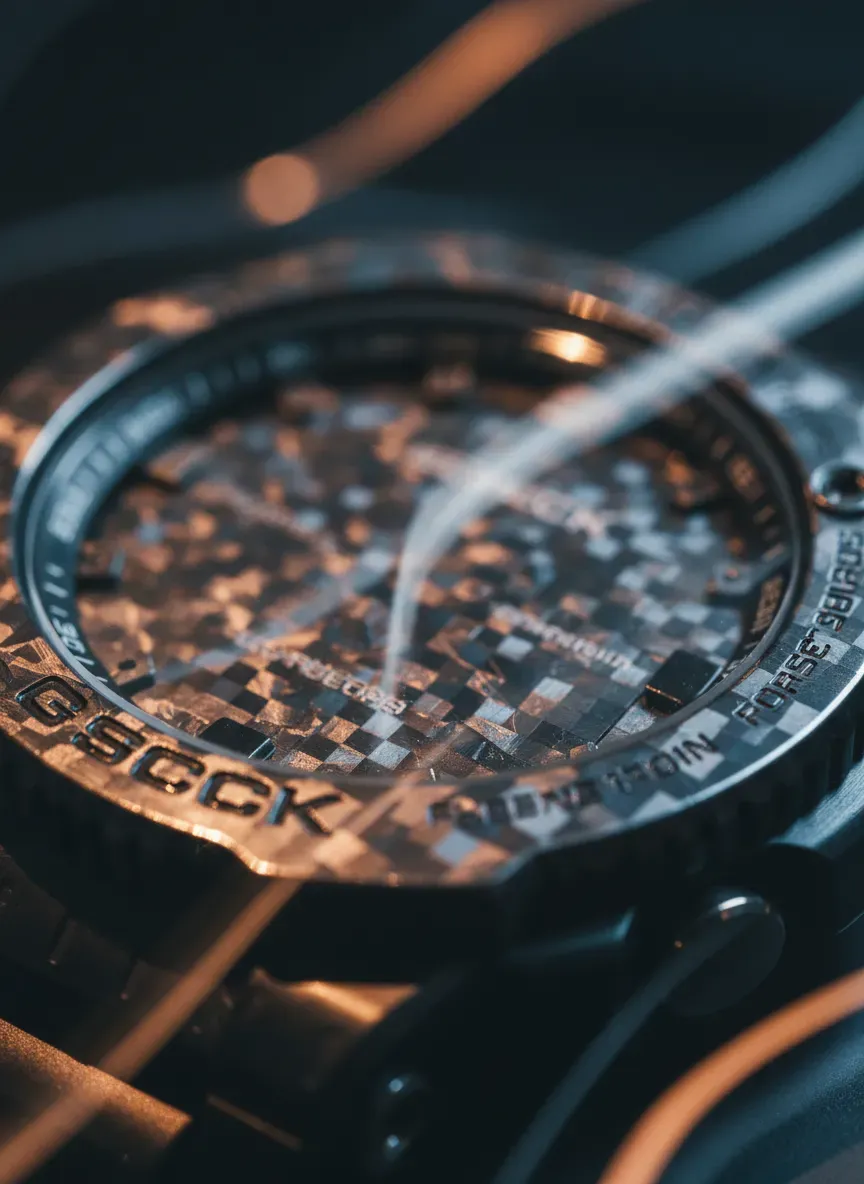
When you examine the patina on an old-school dive watch from the 1960s, you appreciate the history of mechanical craftsmanship. The modern, limited-edition G-Shock represents the exact opposite end of the horological spectrum—it is a celebration of hyper-modern, almost sci-fi manufacturing techniques. These aren’t just watches; they are wearable obelisks of Japanese technological obsession.
Decoding This Season’s Unapologetic Heavyweights
The current lineup of limited releases is not for the faint of heart. These models demand attention, require significant wrist real estate, and carry price tags that force you to re-evaluate your definition of a “beater watch.” Here is the granular breakdown of the three models defining this season.
1. The Titanium Sovereign: MRG-B5000 “Kiwami”
If there is a crown jewel in the current G-Shock hierarchy, it is the MR-G line, and specifically, the B5000 iterations. The standard resin square is iconic, but the Casio G-Shock MRG-B5000 takes that foundational DNA and elevates it to an absurd degree.
What makes this season’s limited MR-G a mandatory acquisition for serious collectors? The bezel architecture. Traditional G-Shock metal squares use a single, solid piece of steel or titanium for the bezel. Casio engineers realized that a single piece cannot be perfectly polished in its recessed corners. Their solution? They engineered a proprietary bezel consisting of 25 individually machined components.
This obsessive multi-component structure allows craftsmen to apply Sallaz (often referred to as Zaratsu) polishing to every single microscopic facet before assembly. The top bumper components are forged from Cobarion—a cobalt-chrome alloy that is four times harder than pure titanium and yields a platinum-like brilliance. The band utilizes DAT55G, an aerospace-grade titanium alloy that retains extreme hardness while allowing for intricate brushing.
I’ve worn standard titanium squares, and they are fantastic. But strapping the MRG-B5000 to your wrist is a different physical experience. The articulation of the bracelet links, the flawless distortion-free mirror finishing, and the sheer over-engineering of the internal suspension system (which uses flat springs and silicone buffers) make it an absolute masterclass in material science.
2. The Chromatic Anomaly: MTG-B3000 “Aurora Oval”
Moving slightly down the pricing tier but significantly up the visual impact scale is the MT-G (Metal Twisted G-Shock) series. This season, the Casio G-Shock MTG-B3000 Aurora is dominating the conversation, and for good reason.
The aesthetic hook here is the IP (Ion Plated) coating on the stainless steel bezel, designed to mimic the Aurora Borealis. Casio achieves this via a highly complex thermal vacuum deposition process. The result is a color-shifting gradient that moves fluidly from deep violet to vibrant emerald green depending on the ambient lighting geometry. Because of how the plating process works, no two “Aurora Oval” models are exactly identical. You are essentially buying a unique fingerprint of industrial art.
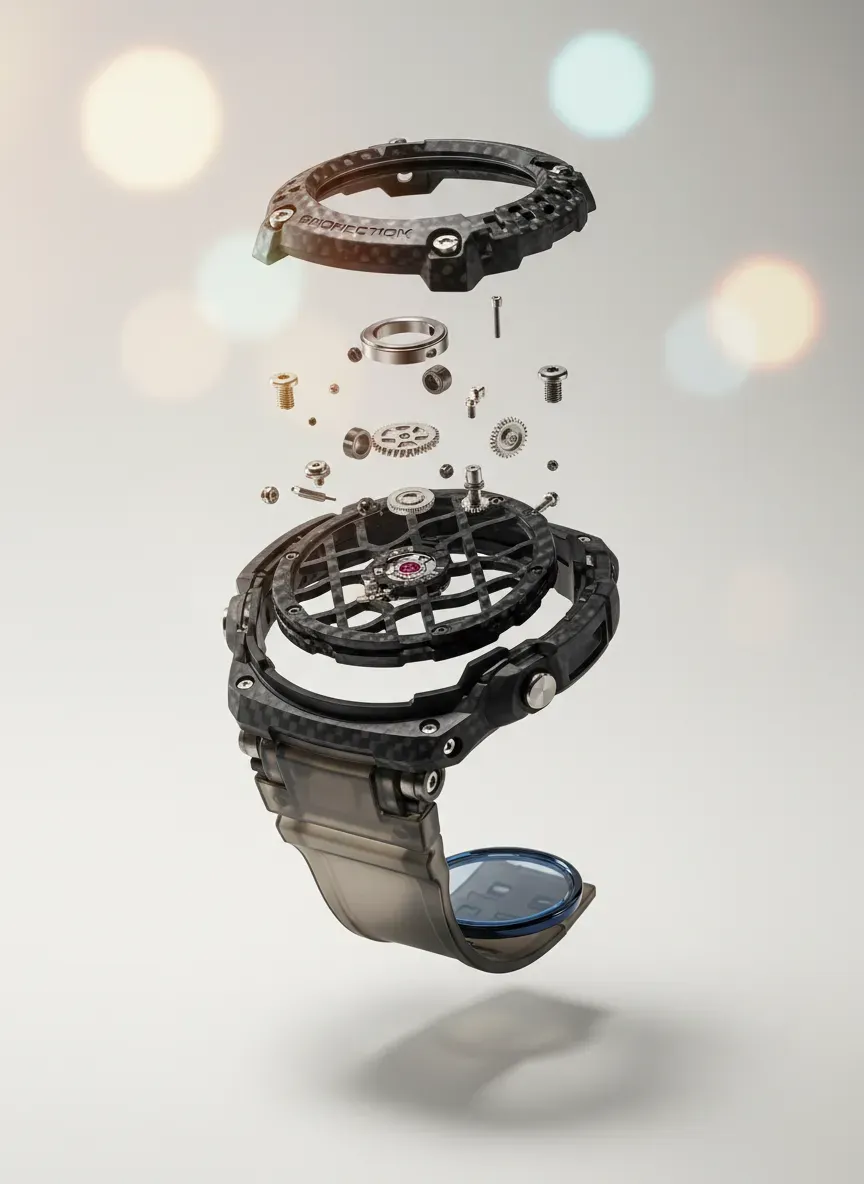
Beneath the flamboyant exterior lies the Dual Core Guard structure. This integrates a carbon-reinforced resin case to house the module, wrapped in a stainless steel exoskeleton. The B3000 chassis is significantly thinner than its predecessors, addressing one of the major historical complaints about the MT-G line—its sheer bulk. By utilizing high-density mounting technology, Casio shaved millimeters off the module, resulting in a watch that easily slips under a tailored cuff despite its aggressive styling.
3. The Deep-Sea Leviathan: Anniversary Frogman GWF-A1000
The Frogman is arguably the most cult-revered sub-line within the entire G-Shock catalog. Originally launched in 1993, the asymmetrical design was created to allow the wrist a full range of motion without the massive case digging into the back of the hand.
This season’s limited release of the Casio G-Shock Frogman GWF-A1000 trades the traditional digital readout for a fully analog display, a controversial move that has paid off beautifully. The watch uses three dual-coil motors to drive the massive hands swiftly during mode changes.
For the limited edition, Casio injected the carbon monocoque case with luminescent resin, creating a subtle, glowing matrix in low light. The sapphire crystal is domed—a rarity in the G-Shock world—providing exceptional legibility underwater while adding a premium, vintage distortion at sharp viewing angles.
The strap is engineered from a fluoroelastomer, a highly durable synthetic rubber completely impervious to hydrolysis and staining. It doesn’t attract lint, it doesn’t degrade in saltwater, and it conforms perfectly to the wrist or over a thick neoprene wetsuit. With ISO 200-meter diver-level water resistance, Bluetooth dive-log connectivity, and a multi-band 6 radio receiver, it is the ultimate expression of functional maximalism.
The Architecture of Rarity (Why Supply Actually Matters)
Collectors often debate the merits of mass-produced luxury versus hyper-limited utility. We see this dynamic play out constantly in high-end horology circles—just look at the endless arguments dissecting the nuanced value propositions between top-tier Swiss watchmakers. But how does rarity actually function in the world of Casio?
It comes down to production bandwidth at the Yamagata facility.
Unlike the standard resin DW-5600s which are pumped out of highly automated factories in Thailand or China by the millions, the MR-G, MT-G, and special anniversary Frogman lines are assembled by hand. The technicians working on the Premium Production Line must earn specific internal certifications before they are allowed to touch these components.
Because Zaratsu polishing a 25-piece titanium bezel takes immense time and manual dexterity, the production bottleneck is physical, not artificial. Casio literally cannot produce more than a few thousand of these globally per year. When a limited edition drops, regional allocations are ruthlessly tight. A flagship boutique in New York might only receive three units of a specific MR-G.
This genuine scarcity is what drives the secondary market. You aren’t paying a premium just for a different colored resin band; you are paying for the labor hours of master craftsmen who are pushing the boundaries of what a tool watch can theoretically be.
Authentication Nuances: Protecting Your Capital
As the retail prices of limited G-Shocks climb past the $3,000 threshold, the counterfeit market has adapted aggressively. Gone are the days of easily spotted “G-Shock” typos and cheap LCD screens. Today’s “super-clones” feature working Bluetooth, solid metal cases, and convincing packaging.
If you are hunting for a sold-out limited edition on the secondary market, you must understand the microscopic tells of authenticity.
Pro Tip: The ultimate acid test for a digital or hybrid G-Shock is the diagnostic screen. By pressing three specific buttons simultaneously (usually A, B, and C, or A, C, and D depending on the module), an authentic Casio will enter a hidden diagnostic mode. This mode tests the LCD segments, the tilt sensor, and displays the internal module firmware version. Counterfeiters almost never bother reverse-engineering this hidden, non-user-facing diagnostic software.
Beyond the software, pay strict attention to the hardware tolerances. On an authentic MR-G, the transition between the brushed and polished surfaces will be razor-sharp, visible under a jeweler’s loupe. Fakes rely on mass-polishing techniques that round off these crucial edges.
Weight is another major indicator. Counterfeiters often use cheap steel alloys instead of the proprietary titanium blends. If a seller lists a limited titanium square but it weighs 160 grams instead of the factory-spec 114 grams, walk away immediately.
Horological Ergonomics: Taming the Beast on the Wrist
There is an unspoken reality about collecting high-end G-Shocks: they are unapologetically massive. We are talking about case diameters that routinely flirt with 50mm and thicknesses that rival mechanical chronographs.
How do you wear a monolithic piece of titanium and resin without looking like you strapped a hockey puck to your arm?
The secret lies in the lug-to-lug geometry. Casio engineers are acutely aware of wrist dynamics. You’ll notice that the straps on premium models plunge straight down from the case rather than flaring outwards. The MT-G B3000, for instance, utilizes a highly articulated first link that immediately contours to the radius of your wrist.
This means a 51mm G-Shock actually wears significantly smaller than a 44mm Swiss diver with rigid, extended lugs.

Styling these pieces also requires a specific mindset. You cannot hide a neon-green forged carbon Frogman under a tight French cuff—and you shouldn’t try. These watches are statement pieces meant to anchor an outfit. I love pairing a highly polished MR-G with unstructured Italian tailoring. The high-low friction between a bespoke wool jacket and an over-engineered Japanese survival tool creates an incredibly compelling sartorial tension.
Value Retention and the Secondary Market Geometry
Let’s address the financial elephant in the room. Does a $4,000 Casio hold its value?
The data points to a surprisingly resilient secondary market, provided you understand the hierarchy of releases. Standard production MR-Gs will experience standard depreciation, much like a regular production luxury car. However, the limited editions—specifically anniversary models, specific collaborations, and mechanically unique releases—often experience an initial spike upon selling out, followed by a stabilized plateau.
Look at the historical trajectory of the titanium square TVA and TVB models (the “Virtual Armor” series). They retailed for around $1,650 and $1,700 respectively. Upon selling out, they quickly commanded premiums of 20-30% on forums and auction sites.
To navigate this market successfully, keep these parameters in mind:
Key Takeaways for the Strategic Collector
- Module Complexity Matters: Collectors pay premiums for models featuring full Bluetooth integration, Tough Solar, and Multi-Band 6 capabilities combined.
- Packaging is Paramount: A missing limited-edition presentation box can easily slash 20% off the resale value. The cardboard outer sleeve, the specific warranty card, and even the original hangtags must be meticulously preserved.
- Material Novelty Wins: Resin fades. Titanium, Cobarion, and Forged Carbon are what drive long-term desirability in the modern era of Casio collecting.
- Condition over Everything: Unlike vintage mechanical watches where “patina” and scratches can add rugged charm, premium G-Shocks are valued for their flawless futuristic finishes. A deep scratch in an IP-coated bezel severely damages its liquidity.
The Collector’s Mindset (Common Pitfalls)
A trap many new enthusiasts fall into is attempting to collect everything. Casio’s release schedule is relentless. They drop dozens of colorways, minor collaborations, and regional exclusives every single month. Trying to keep up is an exercise in financial exhaustion and physical clutter.
The most impressive collections I have seen belong to individuals who exercise ruthless curation. They don’t buy ten $150 resin models; they save and hunt for one exceptional $1,500 limited piece. They focus on a specific lineage—perhaps acquiring every major iteration of the Frogman series, or exclusively hunting down Yamagata-produced titanium squares.
Another frequent mistake is neglecting the solar batteries. These watches are engineered to survive the apocalypse, but locking a Tough Solar G-Shock in a dark pelican case for six months will drain the internal capacitor. If the capacitor fully dies, it often loses its ability to hold a maximum charge, requiring a delicate module teardown to replace. Keep your solar models near a window or in a glass-top watch box to maintain their operational health.
The Bottom Line
The era of viewing Casio strictly as a purveyor of disposable tool watches is dead. The brand has successfully engineered a lane where hyper-durable utility violently collides with obsessive, artisanal craftsmanship. Securing one of this season’s limited editions isn’t just about telling the time; it is about strapping a piece of uncompromising Japanese micro-engineering to your wrist. Whether you lean toward the stealth wealth of the MR-G titanium squares or the extroverted chromatic explosion of the MT-G Aurora, these timepieces demand respect—both on the wrist and in the collector’s vault.