Top Men's Luxury Watch Brands: From Rolex to Patek Philippe
Discover the nuanced hierarchy of men's luxury watches. An expert breakdown of haute horlogerie, from the Holy Trinity to the dominance of Rolex and Omega.
Mar 11, 2026 - Written by: Linda Wise
Strap a finely tuned mechanical watch to your wrist, and you are immediately tethered to centuries of obsessive human engineering. I’ve personally found that the moment you lock the clasp on a truly exceptional timepiece, your relationship with time itself shifts. You aren’t just wearing a tool that tells you when your next meeting begins. You are wearing a micro-mechanical city on your wrist—a beating heart of springs, gears, and rubies that operates entirely independent of the digital grid.
Navigating the landscape of men’s luxury watches can feel like walking into a secret society where everyone speaks a different language. From terms like haute horlogerie and guilloché to heated debates over the superiority of a Co-Axial escapement versus a traditional Swiss lever, the learning curve is exceptionally steep.
This guide strips away the marketing fluff. We are going to look under the hood of the most prestigious watchmakers on the planet, dissecting why certain names command reverence, why others drive speculative frenzy, and how you can strategically navigate this fascinating market.
Quick Comparison: Top Picks
| Product | Rating | Check Price |
|---|---|---|
| Rolex Submariner | ⭐⭐⭐⭐⭐ | View on Amazon |
| Omega Speedmaster Professional | ⭐⭐⭐⭐½ | View on Amazon |
| Seiko Prospex | ⭐⭐⭐⭐ | View on Amazon |
The Holy Trinity of Haute Horlogerie
If you spend any amount of time around serious collectors, you will inevitably hear whispered reverence for the “Holy Trinity” (or the Big Three). This trifecta consists of Patek Philippe, Audemars Piguet, and Vacheron Constantin. These are the undisputed architects of traditional Swiss watchmaking. They didn’t just survive the Quartz Crisis of the 1970s and 80s; they fundamentally redefined what a mechanical watch represented when battery-powered accuracy threatened to render them obsolete.
Patek Philippe: The Custodians of Time
“You never actually own a Patek Philippe. You merely look after it for the next generation.”
It is arguably the most successful advertising slogan in luxury history, precisely because it rings true. Patek Philippe operates at the absolute zenith of brand prestige. Founded in 1839, the Geneva-based manufacturer is fiercely independent, currently owned by the Stern family.
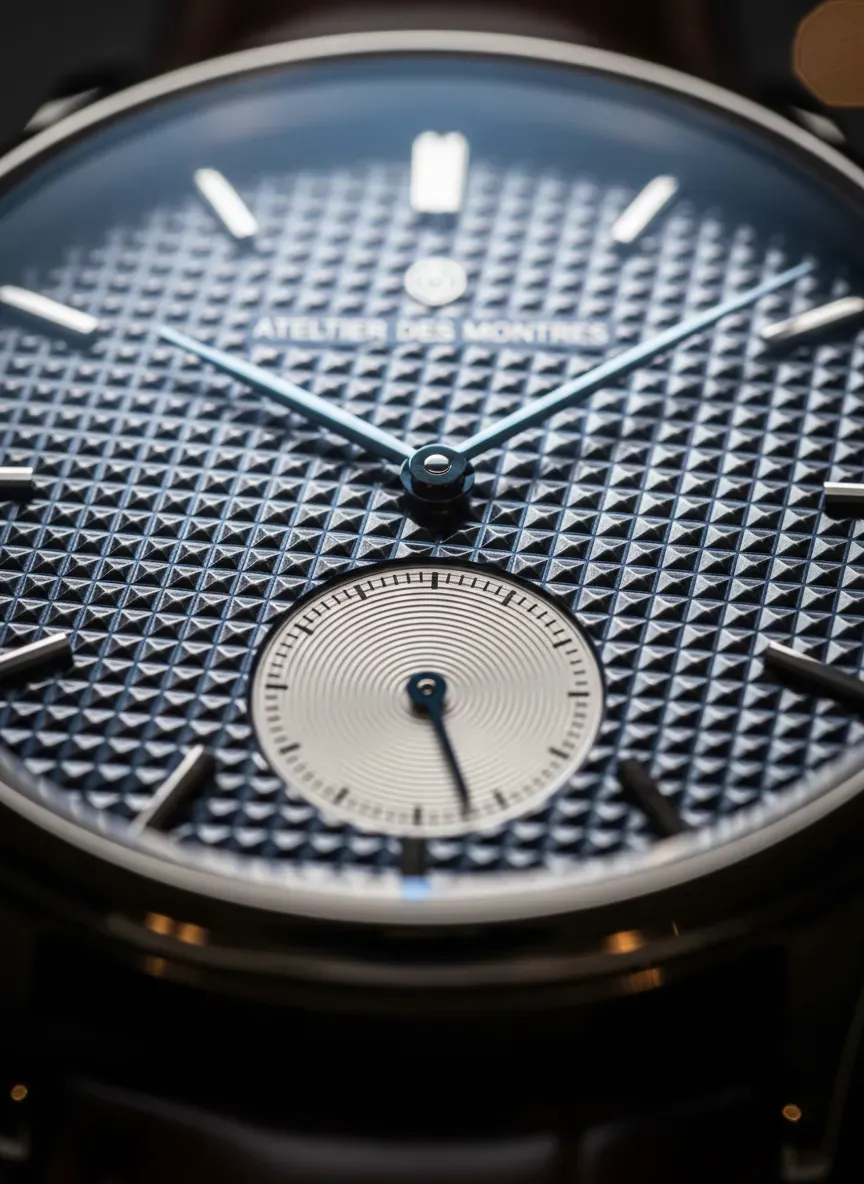
What separates Patek from the rest of the pack is their uncompromising dedication to finishing. Look at the movement of a Patek Philippe through a sapphire caseback. You’ll notice that every bridge features immaculate Côtes de Genève (Geneva stripes). The edges of the metal are chamfered and polished by hand—a technique known as anglage.
The brand is most famous among mainstream buyers for the Nautilus, a luxury steel sports watch designed by the legendary Gérald Genta in 1976. But the true soul of Patek lies in their Grand Complications. Minute repeaters that chime the time with acoustic perfection, perpetual calendars that account for leap years without manual adjustment until the year 2100, and split-seconds chronographs. If you are finding the perfect high-end piece in our ultimate gift guide to mark a massive life milestone, a Patek Calatrava remains the quintessential dress watch.
Audemars Piguet: The Disruptors
Audemars Piguet (AP) represents the rebellious sibling within the Holy Trinity. Hailing from Le Brassus in the Vallée de Joux, AP has a history of incredible technical innovation, including creating the first minute-repeating wristwatch in 1892.
However, everything changed in 1972. The Swiss watch industry was hemorrhaging cash, terrified by the influx of cheap, highly accurate quartz watches from Japan. AP took a massive gamble. They hired Gérald Genta to design a watch made of stainless steel that would be priced higher than most gold watches of the era.
The result was the Royal Oak. Featuring an octagonal bezel secured by eight visible, hexagonal gold screws and an integrated bracelet, it was a massive shock to the system. It took years to catch on, but today, the Royal Oak is a cultural monolith. It graces the wrists of athletes, musicians, and tech billionaires.
Here’s the real kicker with AP: they lean heavily into avant-garde materials. While Patek sticks primarily to precious metals, AP experiments with black ceramics, forged carbon, and frosted gold. Their Offshore and Concept lines push the boundaries of modern aesthetics while retaining traditional movement architecture.
Vacheron Constantin: The Uninterrupted Legacy
Founded in 1755, Vacheron Constantin holds the title of the oldest continuously operating watch manufacturer in the world. They have never closed their doors. Not during the French Revolution, not during either World War, and not during the Quartz Crisis.
Vacheron is the quietest of the Big Three, often favored by “stealth wealth” collectors who want the absolute peak of horological finishing without the immediate mainstream recognition of a Nautilus or a Royal Oak.
Their Overseas collection is their answer to the luxury steel sports watch trend, featuring a bezel inspired by the Maltese Cross (the brand’s emblem) and a highly ingenious quick-release strap system. But to truly understand Vacheron, you have to look at their Les Cabinotiers department. This bespoke division creates unique, one-off commissions for the world’s elite, producing watches with multiple faces and dozens of complications that defy the limits of micro-engineering.
The Crown and The Challenger: Rolex vs. Omega
Step slightly outside the rarefied air of the Holy Trinity, and you hit the heavyweight division. The rivalry between Rolex and Omega is the most compelling narrative in modern watchmaking. Both brands produce incredibly robust, reliable, and historically significant timepieces, yet their philosophies are distinctly different.
Rolex: The King of Brand Equity
Rolex does not produce highly complicated watches. You won’t find a Rolex minute repeater or a tourbillon. What you will find is the relentless, iterative pursuit of perfection in the realm of the everyday tool watch.
Hans Wilsdorf founded Rolex with a singular vision: to make the wristwatch accurate, waterproof, and self-winding. He succeeded brilliantly. The invention of the Oyster case in 1926 effectively birthed the waterproof watch. The subsequent development of the Perpetual rotor gave us the automatic winding mechanism we take for granted today.
The Rolex Submariner is the archetype of the modern dive watch. The Daytona is the undisputed king of chronographs. The Day-Date (often called the “President”) is the ultimate symbol of success.
Rolex’s power lies in consistency. A Submariner from 1985 looks remarkably similar to a Submariner from 2024. They make glacial, highly calculated changes to their designs. They use their own proprietary 904L stainless steel (Oystersteel), which takes a higher polish and is more corrosion-resistant than the industry standard 316L. They even smelt their own gold.
The modern reality of Rolex, however, is scarcity. Walking into an authorized dealer and buying a steel sports model at retail price is nearly impossible for a new client. This artificial (or demand-driven) scarcity has spawned a massive secondary market, turning these watches into highly liquid, speculative assets.
Omega: Master Chronometers and Moon Landings
If Rolex is the impenetrable fortress, Omega is the brilliant innovator continuously storming the gates. Omega’s historical catalog is mind-boggling, and they have the single greatest marketing trump card in the history of consumer goods: The Speedmaster Professional was the first watch worn on the moon.
When NASA needed a watch for the Apollo astronauts, they tested chronographs from several top brands, subjecting them to extreme temperatures, vacuum environments, and violent vibrations. Only the Omega Speedmaster survived.
Beyond space exploration, Omega has actively revolutionized modern watchmaking technology. In 1999, they commercialized the Co-Axial escapement, invented by English watchmaker George Daniels. The escapement is the brain of the watch, controlling the release of energy. The Co-Axial design drastically reduces sliding friction, meaning the watch requires less lubrication and maintains its accuracy longer between services.
Today, Omega submits their watches to METAS (the Swiss Federal Institute of Metrology) to achieve Master Chronometer certification. This guarantees the watch is accurate to 0/+5 seconds a day and can withstand magnetic fields up to 15,000 gauss. If you are weighing the differences in our Omega vs. Rolex breakdown, it often comes down to Rolex’s undeniable prestige versus Omega’s superior modern technology and availability.
Don’t overlook their back catalog, either. The the incredible heritage behind a vintage Omega Seamaster offers some of the best entry points into serious vintage collecting.
The Independents and Avant-Garde Masters
While the massive conglomerates (like Swatch Group, Richemont, and LVMH) control the lion’s share of the industry, a small group of independent watchmakers and distinct regional powerhouses are producing some of the most exciting work in the world.
F.P. Journe: The Modern Genius
François-Paul Journe is widely considered the greatest living watchmaker. Operating out of central Geneva, his motto is Invenit et Fecit (He invented it and made it).
Journe’s watches are instantly recognizable. He uses distinctive hands, incredibly elegant dials, and cases crafted from platinum or 18k rose gold. But the true magic is inside. Journe famously crafts his movement baseplates and bridges out of solid 18k rose gold—an incredibly difficult and expensive material to machine for this purpose.
His Chronomètre à Résonance is a masterpiece of physics, utilizing two independent balance wheels that beat in sympathy with one another, naturally synchronizing to provide unmatched chronometric precision. An F.P. Journe on the wrist signals to other collectors that you have bypassed the hype and care purely about horological genius.
Richard Mille: The Racing Machine on the Wrist
If F.P. Journe is classical music, Richard Mille is heavy metal played through a stadium sound system. Founded in 2001, the brand threw out the traditional rulebook.
Richard Mille builds watches the way Formula 1 teams build cars. They use grade 5 titanium, carbon TPT, graphene, and sapphire crystal to create intensely durable, impossibly lightweight tourbillons. Rafael Nadal famously wears his $1 million+ Richard Mille while playing professional tennis—a feat that would destroy the delicate escapement of almost any other mechanical watch.
The aesthetic is loud, skeletonized, and tonneau-shaped. They are fiercely expensive, highly exclusive, and represent the ultimate modern flex.
Grand Seiko: Japanese Zaratsu Perfection
For decades, Swiss watchmakers looked down on Japanese horology, viewing it strictly through the lens of mass-produced quartz. Grand Seiko completely shatters that illusion.
Operating under the Seiko umbrella but functioning as an entirely separate, high-end entity, Grand Seiko arguably produces the best dials and case finishing in the industry for under $10,000. Their signature Zaratsu polishing technique creates flat surfaces with distortion-free, mirror-like reflections that play with light in a way Swiss watches rarely achieve.
Grand Seiko dials are deeply inspired by the nature surrounding their two main studios in Japan. The famous “Snowflake” dial mimics the freshly fallen snow outside the Shiojiri studio.
Furthermore, Grand Seiko invented the Spring Drive movement. This proprietary technology combines a traditional mechanical mainspring with an electro-magnetic regulator, resulting in a watch that has the soul of a mechanical piece but the pinpoint accuracy of quartz. The visual result is a seconds hand that sweeps completely smoothly, gliding silently across the dial without the typical ticking stutter.
Practical Applications: Building Your Collection
Understanding the history and the mechanics is only half the battle. Stepping into the market to actually acquire these pieces requires tactical knowledge. The luxury watch market has transformed significantly over the last decade, shifting from an insider hobby to a globally recognized asset class.
The Pitfalls of Grey Market Speculation
You will quickly encounter the term “Grey Market.” Authorized Dealers (ADs) are vetted storefronts directly supplied by the brands. The grey market consists of un-authorized dealers who sell new or lightly worn watches.
Because highly desirable watches (like the Rolex Daytona or the Patek Philippe Nautilus) are impossible to get at retail, they flood the grey market at massive premiums. Buying a watch for double its retail price simply because of social media hype is a dangerous game. Markets fluctuate. We saw a massive contraction in secondary market prices recently after the hyper-inflated peak of 2022.
Buy what you love. If you are purchasing a luxury watch solely as an investment, you are competing against seasoned dealers with massive capital backing. If you buy a Jaeger-LeCoultre Reverso or an A. Lange & Söhne Lange 1 because the mechanics sing to you, market fluctuations won’t matter.
Establishing the “Three-Watch Collection”
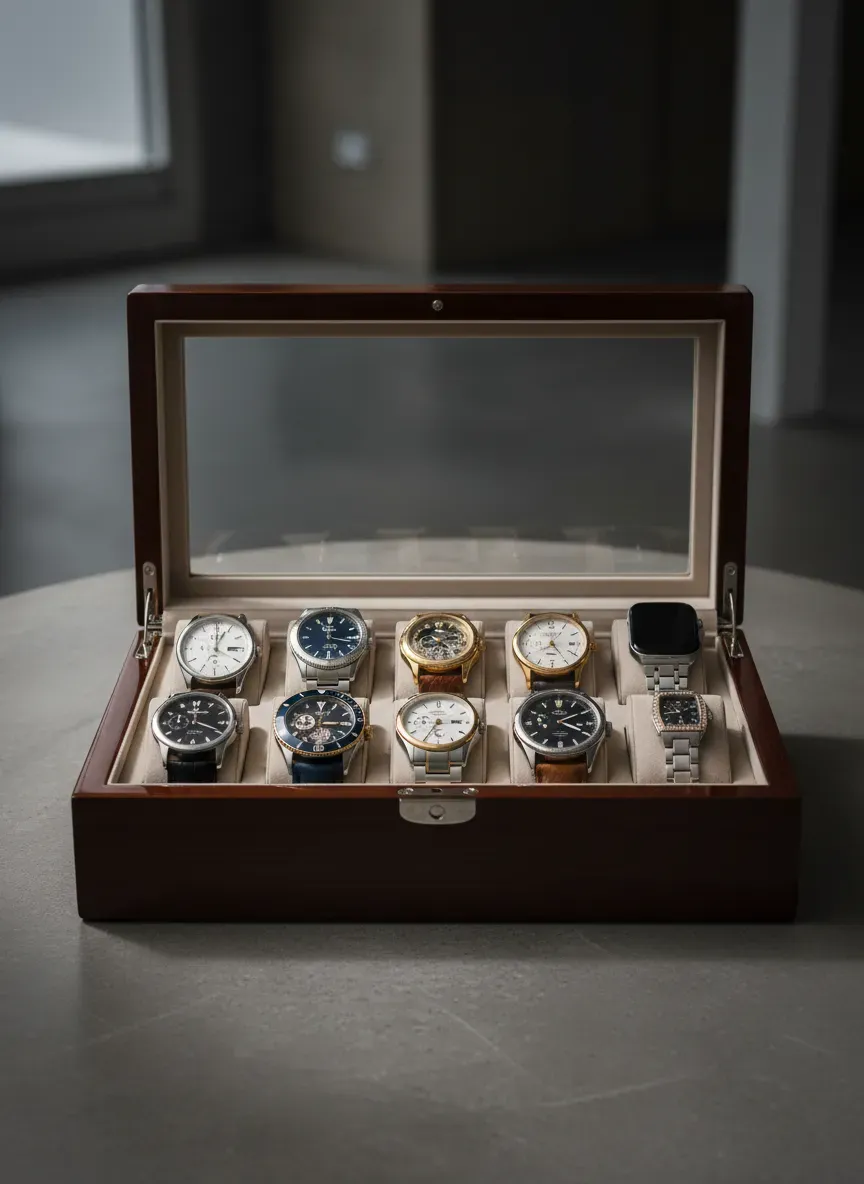
A common strategy for new collectors is building a versatile, three-watch rotation. This ensures you have a piece for every possible scenario without hoarding metal you never wear.
- The Everyday Sports Watch: This is your durable, water-resistant daily driver. The Rolex Submariner, Omega Seamaster, or Tudor Black Bay fits perfectly here. It handles the office, the pool, and the weekend in equal measure.
- The Dress Watch: Thin, elegant, usually on a leather strap. Worn with suits, tuxedos, or sharp evening wear. A Patek Philippe Calatrava, a Cartier Tank, or an Omega De Ville.
- The Complication/Wildcard: This is where you have fun. A chronograph like the Speedmaster, a GMT-Master II for travel, or something entirely avant-garde like a Panerai Luminor.
Pro Tip: The Importance of “Full Sets”
When buying luxury watches, especially on the pre-owned market, always strive to purchase a “Full Set.” This means the watch comes with its original box, the original warranty papers or card, and any associated booklets. A full set not only verifies the authenticity of the piece but can increase the resale value by 10% to 20% compared to a “naked” watch (watch only).
Key Takeaways for the Aspiring Collector
- Understand Case Proportions: A 44mm watch might look great in a macro photograph but wear like a dinner plate on a 6.5-inch wrist. Pay attention to the “lug-to-lug” measurement, not just the case diameter. If the lugs overhang your wrist, the watch is too big.
- Servicing Costs are Real: Mechanical watches are tiny engines. The oils dry up, and the gears create friction. You need to service a luxury watch every 5 to 7 years. A standard three-hand Rolex might cost $800 to service, while an AP Royal Oak Chronograph could easily exceed $2,000. Factor this into your budget.
- Water Resistance is Misunderstood: A watch rated to “30 meters” is not safe for diving 30 meters. It is barely safe for washing your hands. You want a minimum of 100m of water resistance and a screw-down crown if you plan on swimming with your watch.
Caring for Mechanical Art
Once you have secured your luxury timepiece, maintaining its integrity becomes paramount. These are robust tools, but they are not invincible.
Magnetic fields are the silent killer of mechanical accuracy. Laptops, iPads, and large speakers emit magnetic fields that can magnetize the hairspring inside your watch. When this happens, the coils of the spring stick together, causing the watch to run erratically fast—sometimes gaining minutes a day. While brands like Omega have engineered anti-magnetic movements to combat this, older vintage pieces are highly susceptible. If your watch suddenly starts running fast, take it to a watchmaker; demagnetizing it takes exactly thirty seconds and is often done for free.
Watch winders are another heavily debated topic. If you own a perpetual calendar that takes thirty minutes to set properly, keeping it on a winder when not in use is a logical choice. However, if you own a standard time-only automatic watch, leaving it running on a winder 365 days a year simply adds unnecessary wear and tear to the movement. Let the mainspring wind down. Setting the time is part of the tactile joy of ownership.
Finally, insure your collection. Standard homeowner or renter policies usually cap out at $1,000 to $2,000 for jewelry theft or loss. You need a dedicated, scheduled policy through a specialist insurer like Hodinkee Insurance or Jewelers Mutual. They cover mysterious disappearance, accidental damage (like dropping it on a tile floor and shattering the sapphire crystal), and theft, usually without a deductible.
The Bottom Line
The world of men’s luxury watches is a labyrinth of history, micro-engineering, and cultural cachet. It is an industry where logic often takes a back seat to emotion. You are paying thousands—sometimes hundreds of thousands—of dollars for an instrument that is technically less accurate than the smartphone in your pocket.
But that is entirely missing the point.
We wear mechanical watches as a rebellion against planned obsolescence. In a world where our technology is discarded every two years for a newer model, a finely crafted mechanical watch represents permanence. A Patek Philippe or a Rolex bought today, if cared for properly, will run exactly the same way a century from now. It will outlive you, carrying the scratches and scuffs of your life’s adventures, ready to be passed down to the next wrist. That kind of legacy is something you simply cannot digitize.