5 Best Swiss Automatic Watches for Beginners
Discover the top 5 entry-level Swiss automatic watches. A curated guide for purists seeking heritage, mechanical precision, and value in their first serious timepiece.
Feb 11, 2026 - Written by: Brahim amzil
5 Best Swiss Automatic Watches for Beginners
There is a specific moment in every watch enthusiast’s life when the battery dies.
Not the literal battery of a quartz watch, though that happens too. It’s the moment the idea of a battery dies. You look down at your wrist and realize you want something with a heartbeat. You want a machine powered by nothing more than the movement of your arm and the tension of a spring. You want the sweeping second hand, the intricate dance of gears, and the centuries of history packed into a 40mm steel case.
You want a Swiss automatic.
But walking into the world of horology can feel like stepping into a private club where everyone speaks a different language. Terms like “complications,” “bezel action,” and “frequencies” get thrown around casually. And the prices? They can be eye-watering.
Here is the good news: you don’t need to mortgage your house to get a piece of true Swiss heritage. The “entry-level” luxury segment is currently in a golden age. Brands are putting high-grade movements and finishing into watches that are surprisingly attainable.
If you are a purist looking for that first serious timepiece—a watch that earns a nod of respect from collectors but doesn’t require a six-figure salary—this list is for you. We are looking strictly at Swiss-made mechanics. No quartz. No smartwatches. Just pure, spring-driven engineering.
Why “Swiss Made” Still Matters
Before we dive into the metal, let’s address the elephant in the room. Is “Swiss Made” just marketing fluff?
Yes and no.
Legally, for a watch to carry that label, 60% of the manufacturing costs and the final inspection must happen in Switzerland. Some brands skirt the line. But the brands we are discussing today don’t just meet the standard; they define it.
There is a distinct tangible quality to a Swiss automatic. It’s in the weight. It’s in the way the crown turns—the tactile resistance rather than a loose spin. It’s the difference between a door slamming on a budget sedan and the reassuring “thud” of a luxury car door. When you buy Swiss, you are buying into an infrastructure of quality control and history that dates back to the farmers in the Jura Mountains making gears during the harsh winters.
Let’s get into the metal.
1. Hamilton Khaki Field Auto: The Rugged Standard
If you ask ten watch collectors to recommend a first Swiss automatic, seven of them will immediately say “Hamilton Khaki Field.”
Technically, Hamilton started as an American company in Lancaster, Pennsylvania, supplying watches to the railroads and the US military. Today, they are Swiss-owned (Swatch Group) and Swiss-made, but they have retained that rugged, American utilitarian soul. This isn’t a delicate piece of jewelry; it’s a tool.
The Aesthetics
The Khaki Field Auto is the quintessential “field watch.” It prioritizes legibility above all else. You get a dial with both 12-hour and 24-hour markers—a nod to its military heritage. The case is usually brushed steel, which hides scratches better than polished surfaces. It looks just as good beaten up as it does brand new. Perhaps better.
The Engine
Inside beats the H-10 movement. This is a modified ETA movement (the workhorse of the Swiss industry) that Hamilton has tweaked to provide an 80-hour power reserve.
Think about that. You can take this watch off on Friday evening, leave it on your nightstand all weekend, and when you pick it up Monday morning, it will still be running. For a beginner, this is a massive quality-of-life feature.
Why It’s a Winner
It is versatile. Put it on a leather strap, it looks scholarly. Put it on a NATO strap, it looks ready for a hike. It is the perfect “Go Anywhere, Do Anything” (GADA) watch for under $1,000.
2. Tissot PRX Powermatic 80: The Retro Icon
A few years ago, Tissot looked at the watch market, saw everyone obsessing over 1970s integrated bracelet sports watches (like the Audemars Piguet Royal Oak), and decided to drop a nuclear bomb on the industry.
That bomb was the PRX.
The Design Language
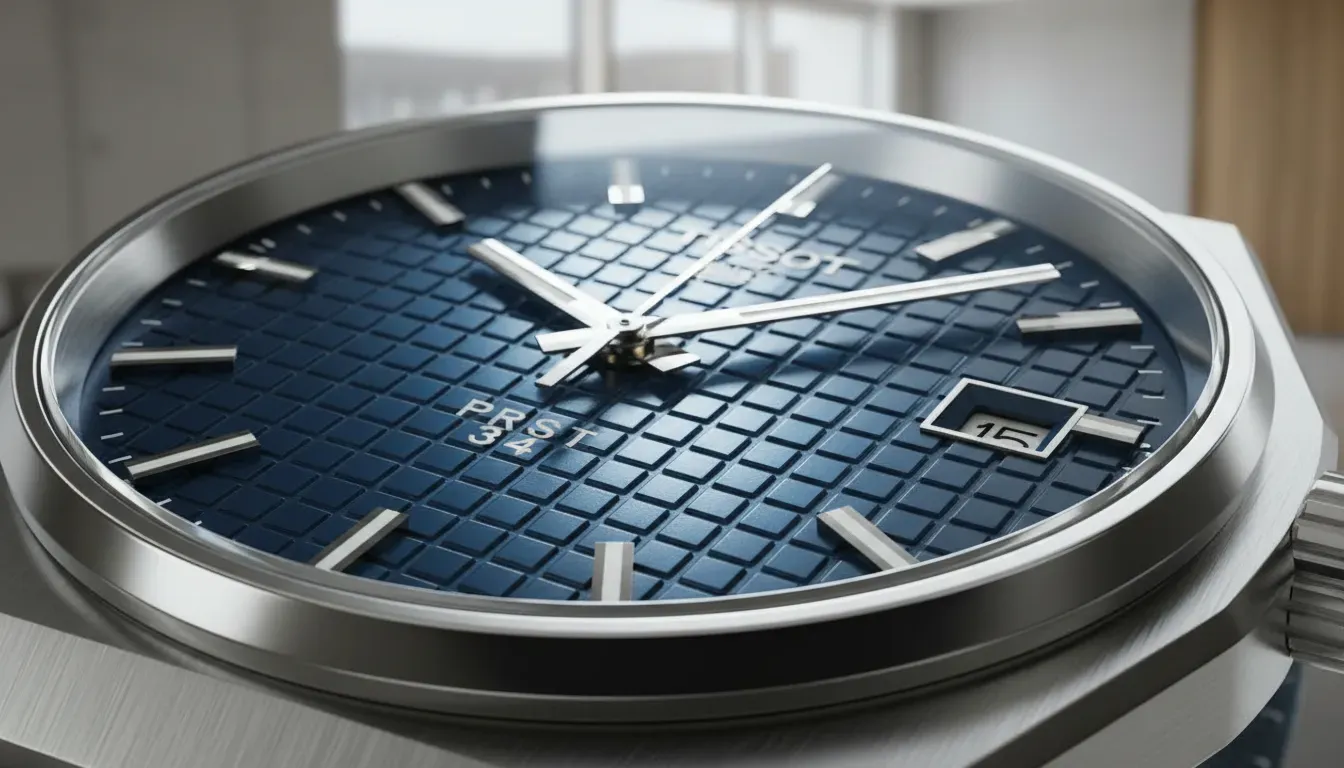
The PRX is unapologetically 70s. The case and the bracelet are integrated, meaning the bracelet flows directly into the watch head without traditional lugs. It creates a sleek, continuous silhouette that catches the light like a disco ball.
The dial features a “waffle” pattern that adds incredible depth and texture. When the light hits those tiny squares, the watch looks five times more expensive than it actually is. It wears incredibly slim on the wrist, sliding under a dress shirt cuff with ease.
The Movement
Like the Hamilton, this runs on the Powermatic 80 movement. It also features a Nivachron balance spring, which makes it more resistant to magnetic fields—a common issue in our modern world full of laptops and smartphones. Magnetism is the silent killer of watch accuracy, causing the hairspring to stick together and the watch to run frantically fast. Tissot solved this problem at an entry-level price point.
Who Is It For?
This is for the beginner who wants style. If the Hamilton is for the guy in the flannel shirt, the PRX is for the guy in the blazer or the sharp polo. It screams “luxury” without screaming “I spent my life savings.”
3. Certina DS Action Diver: The Underrated Tank
If you spend time on watch forums, you will eventually see someone angry that Certina doesn’t get enough love in the United States. They are right. Certina is huge in Europe but flies under the radar elsewhere, which makes it a fantastic choice for a beginner who wants something slightly “non-conformist.”
ISO 6425 Certification
Many watches look like dive watches. The Certina DS Action Diver is a dive watch.
It carries an ISO 6425 certification. This isn’t just a marketing sticker; it means the watch has been rigorously tested for water resistance (usually 300m), shock resistance, magnetic resistance, and thermal shock. It is legally a piece of survival equipment.
The “DS” Concept
“DS” stands for Double Security. Since 1959, Certina has used a system of O-ring seals on the stem, crown, and case back to ensure the movement stays dry even if the crown is uncrewed underwater (though you shouldn’t test that theory).
Build Quality
The bezel action on the Certina puts watches twice its price to shame. It’s crisp, loud, and has zero back-play. The clasp on the bracelet usually features a diver’s extension, allowing you to loosen the watch on a hot day without tools.
If you want a Submariner aesthetic but have a realistic budget, this is arguably the best “bang-for-buck” diver coming out of Switzerland right now.
4. Oris Big Crown Pointer Date: The Enthusiast’s Choice
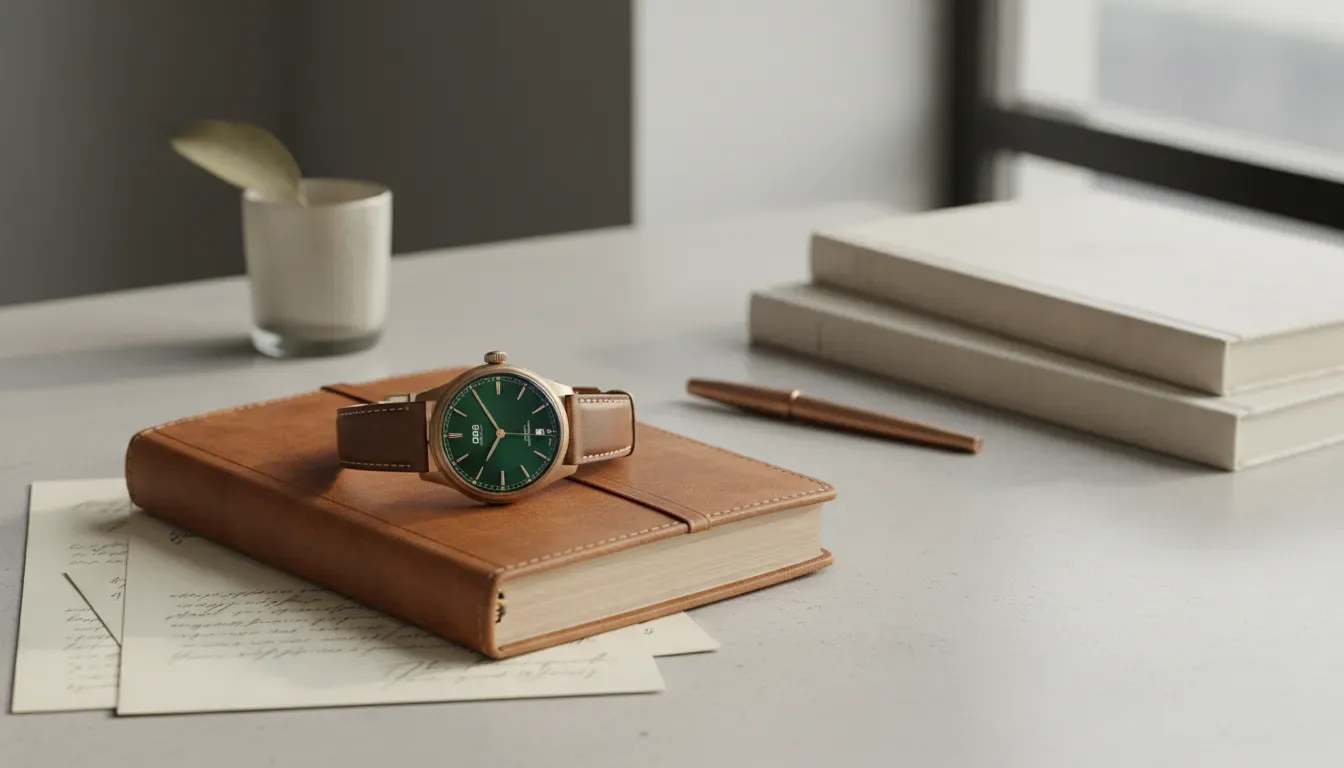
Now we are stepping up a tier. Oris is unique on this list because it is an independent brand. They are not owned by a giant conglomerate like Swatch or Richemont. They only make mechanical watches—no quartz. This gives them a serious amount of “street cred” among purists.
A Design from 1938
The Big Crown Pointer Date has been in production in some form since 1938. It was originally designed for pilots who needed a large crown they could operate while wearing thick leather flying gloves.
The standout feature is the “Pointer Date.” Most watches show the date in a little window at 3 o’clock. Oris prints the numbers 1-31 around the edge of the dial and uses a fourth hand (usually with a red crescent tip) to point to the current date.
Why It’s Special
It feels organic. It feels vintage without trying too hard. The cathedral hands and the coin-edge bezel give it a warmth that modern sports watches often lack.
Oris also uses their signature “Red Rotor” on the movement, which you can see through the sapphire case back. It’s a quirky trademark that reminds you: this is mechanical. It’s alive.
Choosing an Oris as your first watch says something about you. It says you did your research. You didn’t just buy the first brand you saw at the mall. You wanted independence and heritage.
For more on styling vintage-inspired pieces, check out our guide on classic menswear staples.
5. Longines HydroConquest: Entry-Level High Luxury
Longines sits a rung above Tissot and Hamilton on the luxury ladder. They are one of the oldest registered watch logos in the world. When you wear a Longines, you are wearing a brand that timed aviation pioneers and Olympic games.
Modernizing the Diver
The HydroConquest is their answer to the modern luxury diver. While the Certina is a tool, the Longines is a piece of jewelry that happens to be a tank.
The finishing is superior. We are talking about polished surfaces that gleam, ceramic bezels that are virtually scratch-proof, and dials with sunray finishes that change color depending on the angle of the sun.
The L888 Movement
Longines uses the Caliber L888. It’s a proprietary movement developed exclusively for them by ETA. It beats at a unique frequency (25,200 vibrations per hour) to reduce wear and tear while extending the power reserve to 72 hours.
The Presence
This watch has presence. The crown guards are angular and aggressive. The “snowflake” hour hand is distinct. It’s a heavy watch, but in a way that feels reassuringly expensive. If you are looking for a watch that pairs as well with a wetsuit as it does with a tuxedo at a wedding, the HydroConquest is the versatile king of this list.
What to Look for in Your First Swiss Automatic
Buying that first watch is exciting, but it can be a minefield. Don’t get distracted by just the brand name. Here are three critical factors to check before you swipe your card.
1. Sapphire Crystal is Non-Negotiable
At this price point, accept nothing less than Sapphire crystal.
Cheaper watches use mineral glass or acrylic. Acrylic scratches if you look at it wrong. Mineral glass shatters. Sapphire is the second hardest substance on earth next to diamond. You can drag a key across a sapphire crystal and it won’t leave a mark.
All five watches listed above use sapphire. If you are looking at a “luxury” watch and it has mineral glass, walk away.
2. The Service Interval Reality
Mechanical watches are engines. Like a car, they need oil changes. Every 5 to 7 years, the lubricants inside the movement dry up, and the gears start grinding.
A standard service for a three-hand Swiss watch usually costs between $200 and $400. When buying your first watch, factor this into the lifetime cost. The movements in the Tissot, Hamilton, and Certina (ETA-based) are known for being easy and relatively affordable to service.
3. Lug-to-Lug Distance
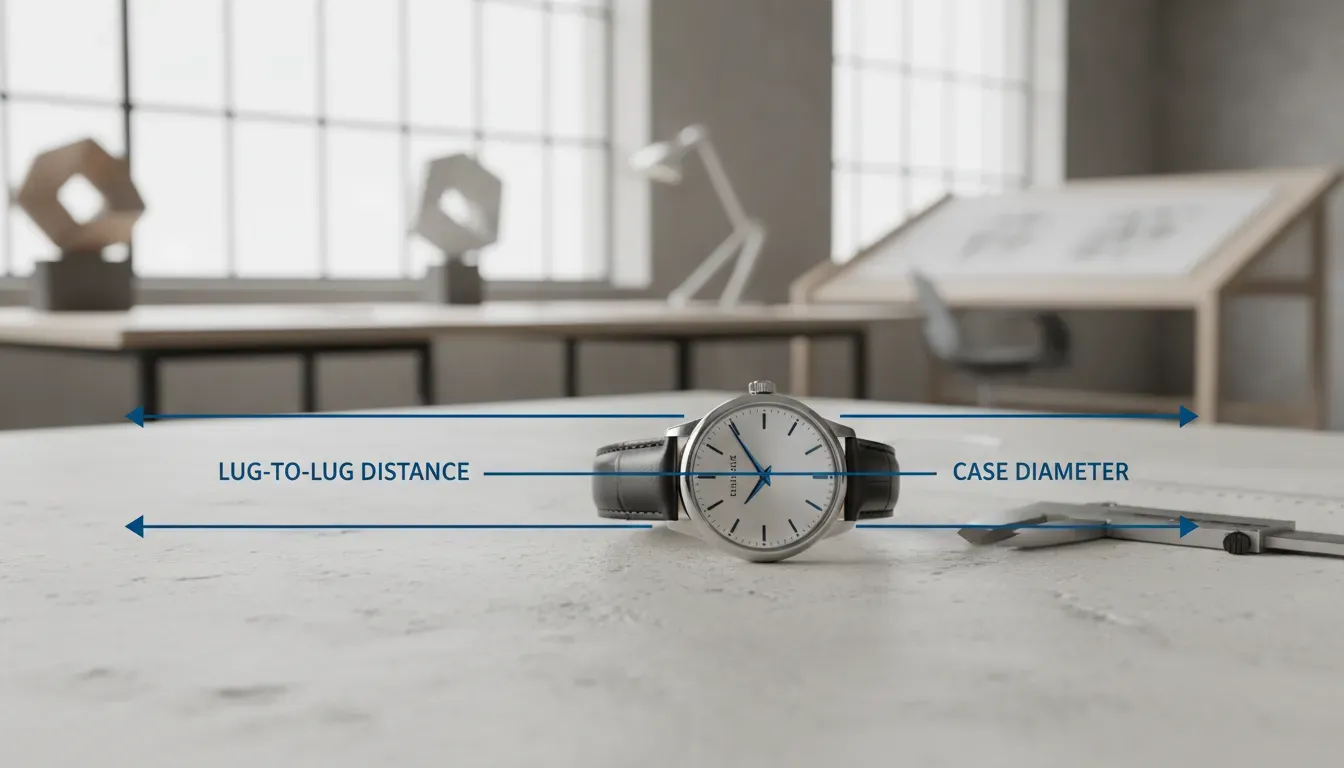
Most beginners obsess over case diameter (40mm, 42mm, etc.). But the most important measurement is actually the lug-to-lug distance. This is the length of the watch from the top tip to the bottom tip.
If the lug-to-lug distance is wider than your wrist, the watch will hang over the edges, looking like a dinner plate strapped to your arm.
- Small/Medium Wrists: Look for a lug-to-lug under 47mm (The Hamilton Khaki 38mm or Oris Big Crown 38mm are perfect).
- Large Wrists: You can handle 48mm-52mm (The Longines and Certina fit here).
Understanding the “Beats”
You will often hear collectors talk about “Hi-Beat” or frequencies. Here is the simple version.
The second hand on a quartz watch ticks once per second. Tick. Tick. Tick.
The second hand on a mechanical watch sweeps because it ticks multiple times per second.
- 21,600 vph (3Hz): Ticks 6 times per second. (Standard for the Powermatic 80 to save energy).
- 28,800 vph (4Hz): Ticks 8 times per second. (Standard for the Oris and most “smooth” sweep watches).
A higher beat rate results in a smoother sweep of the second hand, which is visually pleasing. However, a lower beat rate usually means less friction and a longer power reserve. Neither is “better,” but it’s a trade-off you should be aware of.
Final Thoughts: The Emotional Investment
The best advice for buying your first Swiss automatic is to buy the one you can’t stop looking at.
Specifications are important. Power reserves matter. Water resistance is practical. But ultimately, a mechanical watch is an emotional purchase. It’s an obsolete technology that we keep alive because we love it.
When you buy a Swiss automatic, you are buying a companion. It will be on your wrist during job interviews, first dates, weddings, and quiet Sunday mornings.
Whether you choose the rugged history of the Hamilton, the disco-glam of the Tissot, or the independent spirit of the Oris, you are making a choice to value craftsmanship in a disposable world.
Take your time. precise. Try them on. And welcome to the addiction.
For more insights on building a timeless wardrobe to match your new timepiece, read our deep dive on minimalist fashion essentials.