Case Study: The Resurgence of the Cartier Tank Must
We analyze why the Cartier Tank Must is back on top. A complete guide to sizing, quartz technology, and why this icon is the ultimate style flex.

The resurgence of the Cartier Tank Must is driven by a massive cultural shift toward “quiet luxury” and timeless design, prioritizing aesthetic heritage over complex mechanics. By reintroducing the line with high-autonomy quartz movements and the innovative “SolarBeat” photovoltaic technology, Cartier successfully democratized their most iconic silhouette. This strategic pivot transformed the Tank Must from a historical footnote into the ultimate entry-level luxury watch, offering a sophisticated, reliable, and fashion-forward option that appeals equally to seasoned horologists looking for a “grab-and-go” dress watch and a new generation of style-conscious buyers.
The Geometry of Elegance: A Guide on Case Diameter, Lug-to-Lug, and Wrist Circumference
Buying a watch online is a gamble. Buying a rectangular watch online? That’s high-stakes poker. If you are used to wearing round watches—your Submariners, your Speedmasters, or even your minimalist dress watches—your perception of size is calibrated to diameter.
The Cartier Tank breaks those rules. It laughs at them.
When you see a spec sheet that reads “25.5mm,” your brain screams small. But on the wrist, a rectangular case commands significantly more surface area than a round case of the same width. This serves as a vital lesson for online buyers: stop looking at the width and start looking at the vertical length.
The Lug-to-Lug (L2L) Dictatorship
In the world of the Tank, the lug-to-lug distance is the only metric that truly matters. This is the measurement from the very top tip of the case lugs to the very bottom. If the lugs overhang your wrist, the watch looks like a bracelet borrowed from a giant. If it sits too centrally, it looks like a postage stamp.
Let’s break down the current Tank Must sizing architecture so you don’t end up with buyer’s remorse.
- Small Model (SM): usually around 29.5mm lug-to-lug.
- Large Model (LM): usually around 33.7mm lug-to-lug.
- Extra-Large Model (XL): usually around 41mm lug-to-lug.
For the average male wrist—let’s say between 6.5 and 7.25 inches—the Large Model is the sweet spot. It sounds counterintuitive to buy a “Large” that is barely 34mm long, but you have to factor in the bracelet or strap integration. The Tank sits flat. It has presence.

Wrist Circumference vs. Case Shape
Here is the math nobody tells you. A round watch measures diameter across the center. A rectangular watch measures width. A 33mm square watch wears similarly to a 39mm or 40mm round watch regarding “dial volume.”
If you have a wrist circumference of under 6.5 inches, the Small Model (SM) is a classic choice. It harkens back to the Muhammad Ali or Andy Warhol style of wearing the Tank—small, understated, almost like jewelry. It’s a confident move.
If you are between 6.5 and 7.5 inches, the Large Model (LM) is the definitive “Must.” It provides enough modern presence to not look delicate, but maintains the Art Deco proportions that Louis Cartier intended.
For those with wrists above 7.5 inches, or if you just can’t shake the feeling that you need weight on your wrist, the XL is available. However, be warned: the XL usually houses an automatic movement and features a date window and a guilloché dial, which changes the minimalist aesthetic entirely. For the pure “Must” look, the LM is king.
If you are unsure where your current collection stands in terms of sizing, you might want to measure your current favorites. A simple tool can save you thousands in return shipping fees.
Digital Caliper Measuring Tool
Buying your first serious watch is daunting. If the Tank feels like too much of a leap into dressy territory, you might want to explore other options first. We compiled a list of the top 10 entry-level luxury watches that balance price and prestige, where the Tank Must obviously features heavily.
Technical Analysis: Do Certifications Matter for the Entry-Level Collector?
Let’s address the elephant in the room. The quartz movement.
For years, “quartz” was a dirty word in high-end collecting circles. It implied cheap, mass-produced, and soulless. But the Cartier Tank Must challenges this snobbery head-on. When you are looking at the Must, you aren’t paying for a Tourbillon; you are paying for the Case, the Dial, and the Heritage.
The High-Autonomy Quartz
The movement inside the standard Tank Must is a High-Autonomy Quartz movement. Cartier claims it is good for roughly 8 years before needing a battery swap.
From a technical standpoint, does this lack COSC (Contrôle Officiel Suisse des Chronomètres) certification? Yes. Does it lack the Geneva Seal? Obviously.
But ask yourself: Does it matter?
For an entry-level collector, or even a seasoned one adding a dress watch to the rotation, strict chronometer certification is often a vanity metric. COSC requires mechanical movements to stay within -4/+6 seconds a day. A standard quartz movement is accurate to within a few seconds a month.
The Tank Must is technically superior in accuracy to a $50,000 Patek Philippe Calatrava. That is the irony of horology.
Durability and “Grab-and-Go” Factor
The certification you should actually care about is water resistance and service intervals. The Tank Must generally offers 30 meters (3 bar) of water resistance. This is “splash proof.” Do not swim with it. Do not shower with it.
The value here isn’t in a certification paper; it’s in the “set and forget” nature of the watch. If you rotate between three or four watches, mechanical watches stop. You have to wind them and reset the time. The Tank Must is always ready. It is the faithful soldier in your collection.
The SolarBeat Revolution
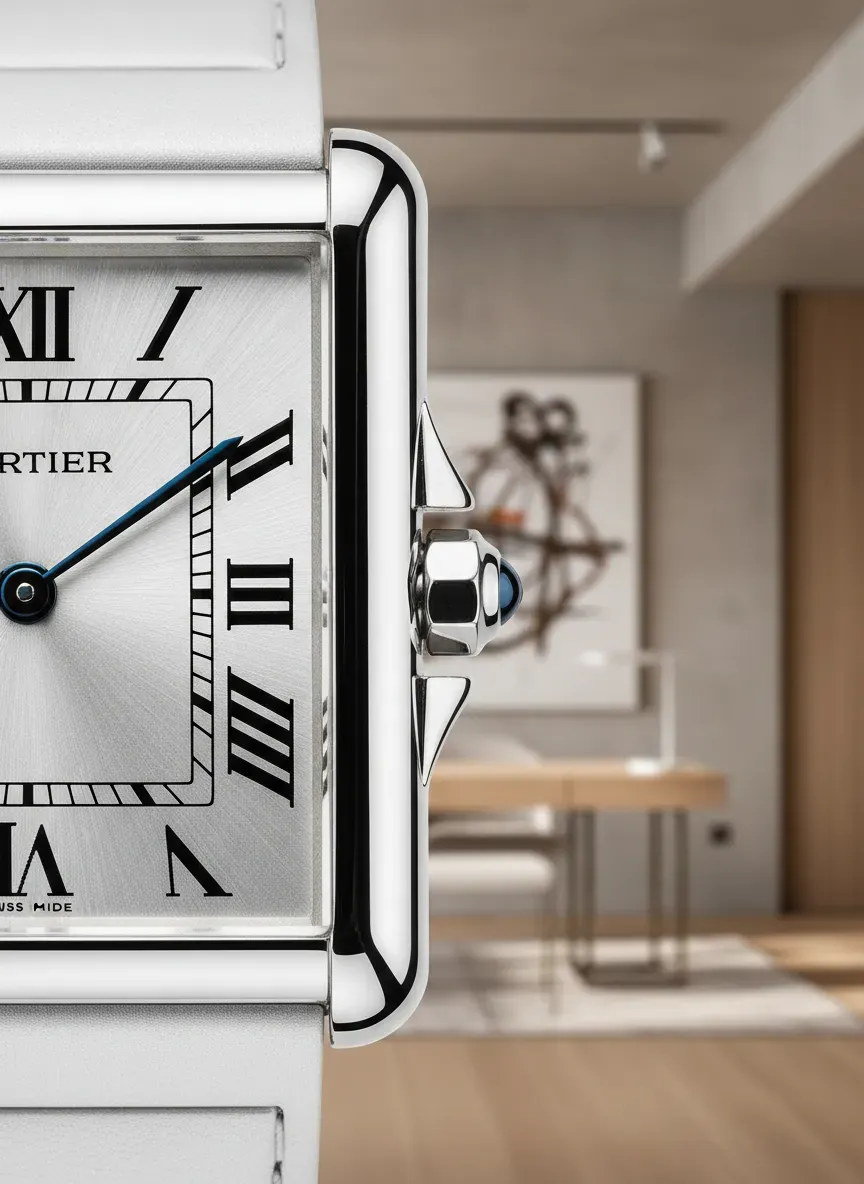
Cartier recently introduced the SolarBeat movement to the Tank Must line. This was a technical masterstroke. The Roman numerals on the dial are actually perforated to allow light to reach the photovoltaic cells beneath.
This isn’t your cheap drugstore solar watch. This is luxury stealth tech. The average lifespan of the rechargeable cell is touted to be upwards of 16 years. For a collector, this removes the annoyance of battery changes and the risk of scratching the caseback every two years.
If you are debating between brands based on technical specs, it gets murky. You might look at other heritage brands to see how they stack up. For instance, in the battle of mid-tier giants, seeing how brands handle quartz vs. automatic is fascinating. You can read our breakdown of Tag Heuer vs Longines to see how other major players balance movement prestige with consumer practicality.
The Comeback: How a Quartz Reissue Became a Must-Have
The “Must de Cartier” line was originally launched in the 1970s. It was a survival tactic. The Quartz Crisis was decimating the Swiss watch industry, and Cartier needed a way to sell luxury to a wider audience without diluting their precious metal exclusivity. They made the cases out of Vermeil (gold-plated silver) and put affordable movements inside. It saved the brand.
Fast forward to the 2020s. The luxury watch market had overheated. Steel sports watches were selling for three times their retail price. The market was exhausted.
Enter the new Tank Must.
The Fashion-Conscious Gentleman’s Choice
Why did this watch explode in popularity recently? It’s the antidote to the “flex culture” of massive dive watches. It represents a return to elegance.
The reissue brought back the monochrome dials—deep blues, greens, and burgundies—stripping away the Roman numerals for a pure, minimalist look. This caught the eye of the fashion world immediately. It wasn’t just a watch; it was a design object.
For the modern gentleman, the Tank Must signals confidence. It says, “I don’t need a 44mm chunk of steel to feel masculine. I appreciate lines, history, and proportion.”
The Luxury Entry Point
The pricing strategy was aggressive. By pricing the quartz Tank Must competitively, Cartier opened the gates. Suddenly, you could own a piece of the same design lineage worn by Clark Gable and Princess Diana for the price of a mid-tier distinctively average mechanical watch.
It became the “Must-Have” because it is the safest bet in the luxury world. It holds value relatively well, it never goes out of style, and it pairs with a t-shirt as well as it pairs with a tuxedo.
While everyone zigs toward the obvious choices like Rolex or Omega, there is immense value in looking at brands that offer this level of heritage at an accessible price point. In fact, Cartier often overshadows other incredible houses that offer similar value. We discuss this in our guide to 7 underrated luxury brands, where we explore other icons that deserve the same resurgence the Tank is enjoying.
The Verdict on the Reissue
The resurgence of the Tank Must is not accidental. It is a lesson in reading the room. Cartier realized that the modern buyer is tired of waitlists and hype beasts. They wanted something beautiful, available, and historically significant.
The quartz movement is not a bug; it’s a feature. It keeps the profile slim (approx 6.6mm thin), the price accessible, and the ownership experience stress-free.

For those looking to keep their growing collection in top condition, especially if you are mixing quartz pieces like the Tank with mechanical ones, proper storage is key. You don’t need a winder for a Tank, but you do need a safe harbor.
Final Thoughts
The Cartier Tank Must proves that you don’t need to be a movement snob to appreciate fine watchmaking. Whether you opt for the SolarBeat, the standard high-autonomy quartz, or hunt down a vintage mechanical piece, the silhouette remains the star.
It is a masterclass in case design. It teaches us that size is relative, that elegance is quiet, and that sometimes, the best way to move forward is to look back at what worked 50 years ago. The Tank Must is not just a watch you buy; it’s a watch you wear. And there is a world of difference between the two.