Case Study: The Rise of the Tissot PRX and Integrated Bracelets
An in-depth analysis of how the Tissot PRX revived the 1970s integrated bracelet trend, disrupted the affordable watch market, and became a modern horological icon.
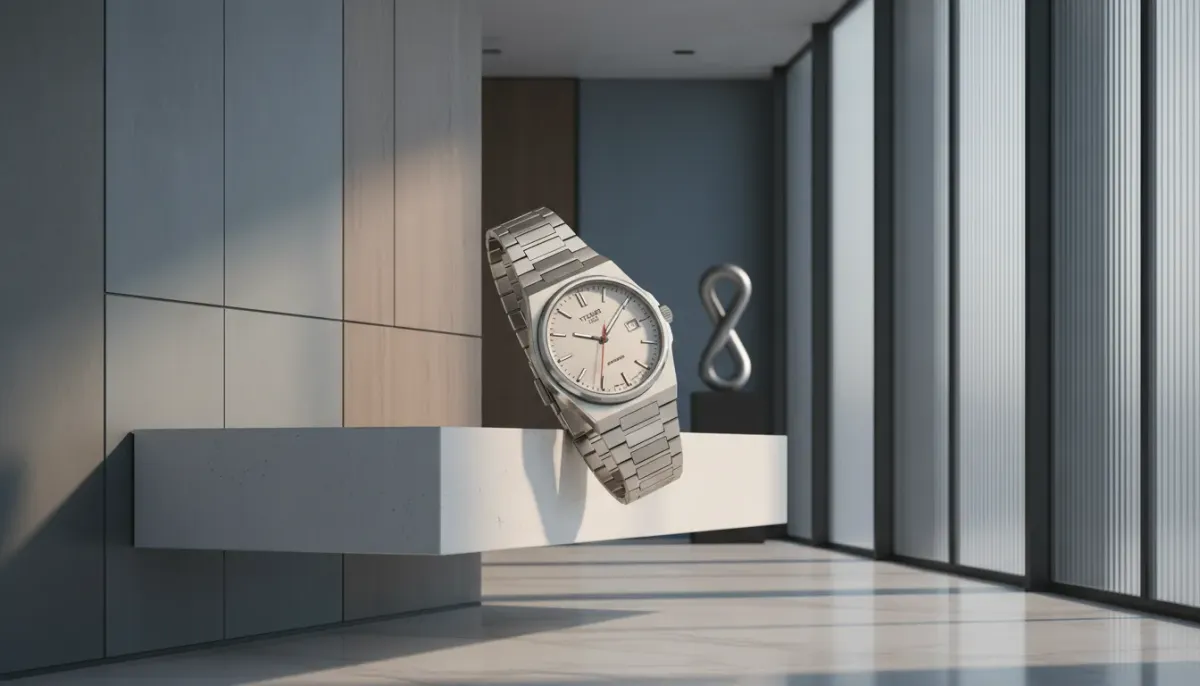
Feb 11, 2026 - Written by: Brahim amzil
Case Study: The Rise of the Tissot PRX and Integrated Bracelets
For a long time, if you wanted the sleek, seamless look of an integrated bracelet sports watch, your wallet was going to hurt. You were essentially staring down the barrel of a five-figure price tag for the likes of an Audemars Piguet Royal Oak or a Patek Philippe Nautilus. The entry-level market? It was a barren wasteland of derivative designs and clunky lugs.
Then 2021 happened.
Tissot, a heritage Swiss brand that had been somewhat sleepy in the eyes of modern hype-beasts, dropped the PRX. It wasn’t just a new model; it was a cultural reset button for the affordable luxury segment. Suddenly, the “Genta” aesthetic—that sharp, angular 1970s vibe—was accessible to the guy who didn’t have a trust fund.
This isn’t just a review of a watch. It’s an analysis of a perfect storm. We need to look at how a reissue of a forgotten 1978 quartz model managed to capture the zeitgeist, force competitors to scramble, and arguably redefine what we expect from a $700 timepiece.
The Gap in the Market: A Hunger for the 70s
To understand the explosion of the PRX, you have to understand the vacuum that existed before it arrived. The watch world is cyclical. We spent the early 2000s obsessed with oversized divers, and the 2010s were dominated by the “vintage reissue” craze—mostly field watches and skin divers.
But there was an itch that wasn’t being scratched.
Enthusiasts were drooling over the integrated bracelet aesthetic. There is something architectural about a watch where the case flows directly into the bracelet without traditional lugs. It catches the light differently. It feels like jewelry rather than just a tool.
Until the PRX, your options were polarized. You either bought a luxury holy grail piece, or you bought a cheap, questionable homage from AliExpress. There was no Swiss-made, heritage-backed contender in the sub-$1,000 range that actually looked good.
This is where Tissot’s timing was lethal. They didn’t invent a new design; they raided their archives. They found the “Seastar” from 1978, a quartz model that perfectly encapsulated that disco-era glamour. By modernizing the dimensions and cleaning up the dial, they weren’t selling a watch; they were selling a vibe that everyone wanted but couldn’t afford.
Analyzing the PRX Design Language
What makes the PRX work? It’s not complex. In fact, its simplicity is its weapon.
The case shape is a masterclass in geometry. It’s a tonneau (barrel) shape, but sharp. The transition from the case to the bracelet is aggressive yet fluid. When you put a Tissot PRX Powermatic 80 on your wrist, the first thing you notice is the light play.
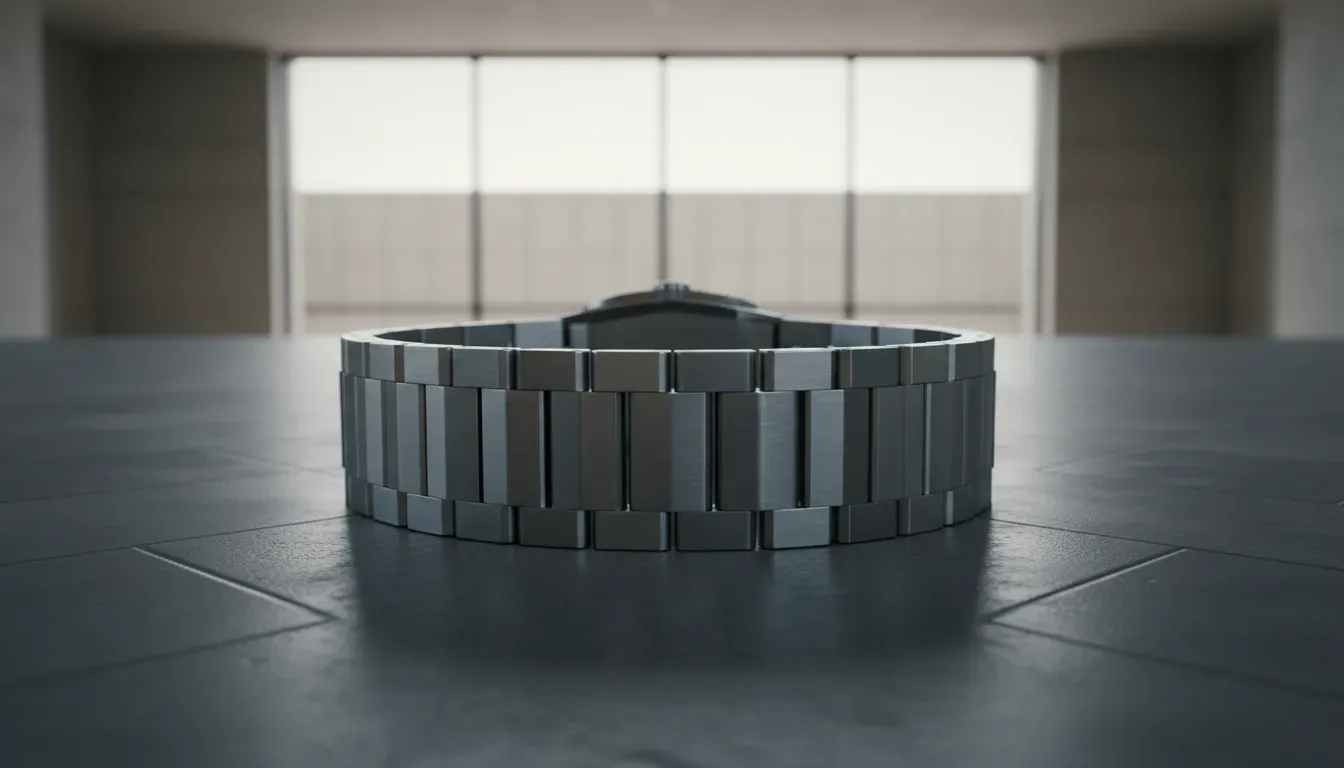
Most affordable watches cut corners on finishing. They are either fully brushed (boring) or fully polished (looks cheap). The PRX mixes vertically brushed surfaces with high-polish chamfered edges. When you move your wrist, the bracelet “rolls” the light. It glimmers. It feels expensive.
The “Waffle” Factor
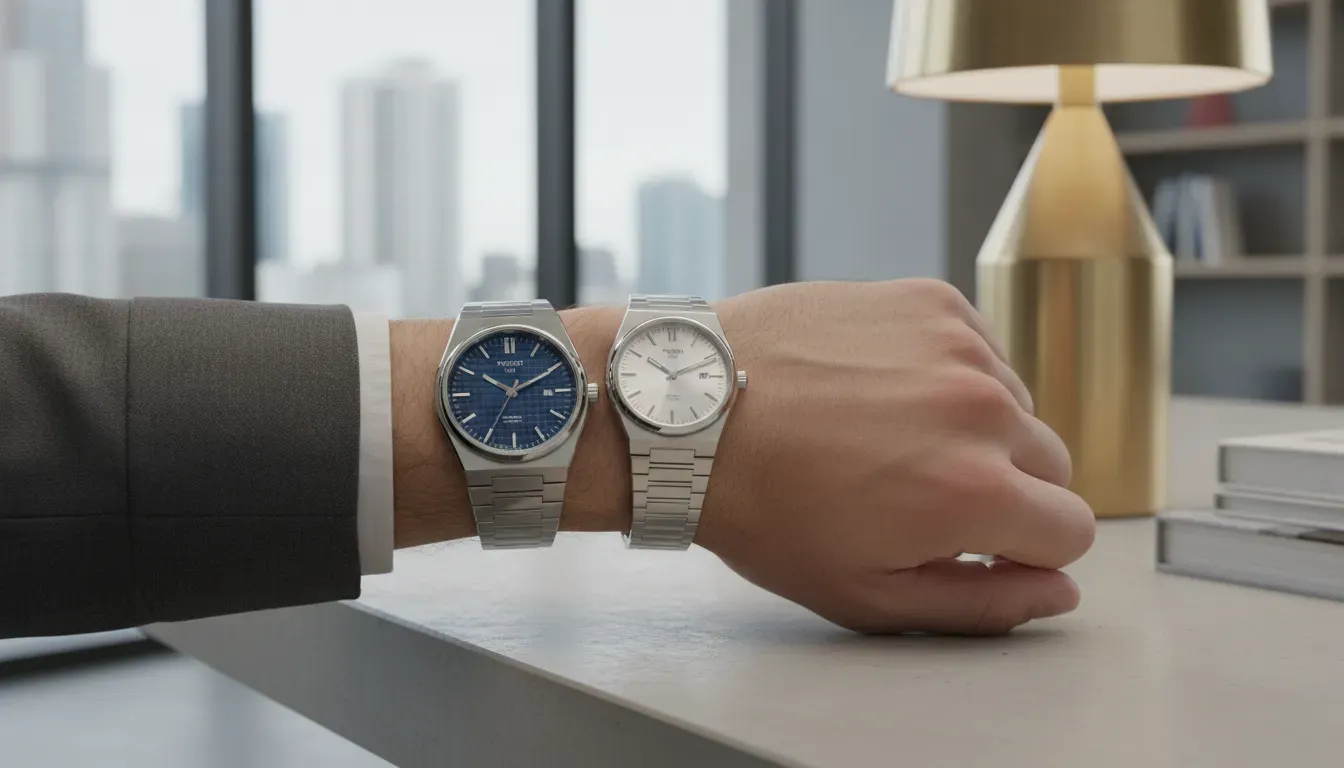
The initial quartz release was a hit, but the automatic version sent things into the stratosphere. Why? The dial. Tissot introduced a tapisserie dial texture—a grid-like “waffle” pattern.
Let’s be honest: this was a direct nod to the Royal Oak. But because it was Tissot, a brand with real history, it didn’t feel like a rip-off. It felt like a democratized alternative. The deep blue, the forest green, and later the ice blue dials gave collectors a variety of flavors that looked stunning on Instagram.
If you are just getting into collecting and want to understand how different eras influence current designs, check out our deep dive on Vintage Watch Trends and Market Cycles.
Strategic Tiering: Quartz vs. Automatic
One of the smartest moves Tissot made was the staggered release strategy.
- The Hook: They launched with the Quartz version first. It was incredibly thin, incredibly accurate, and priced around $375. This was an impulse buy. It got the watch on thousands of wrists immediately.
- The Upsell: Once the hype was built, they dropped the Powermatic 80 version. Now, the enthusiasts who turned their noses up at quartz had a mechanical option with an 80-hour power reserve and that textured dial.
This two-pronged attack allowed Tissot to capture two different demographics simultaneously: the style-conscious consumer who just wants a cool accessory, and the horology nerd who cares about escapements and beat rates.
For those investing in the automatic versions, keeping them running when not in use is key to longevity. A quality Wolf Watch Winder is often the best accessory for a movement like the Powermatic 80 to ensure the lubricants stay distributed.
Redefining “Affordable Luxury”
The term “affordable luxury” is usually marketing nonsense. It’s often used to sell overpriced fashion watches made in sweatshops. The PRX reclaimed the term.
Analyzing the value proposition here is fascinating. You get:
- Heritage: A brand established in 1853.
- Swiss Made: Not “assembled,” but actually Swiss.
- Sapphire Crystal: Scratch-resistant standard.
- Integrated Bracelet: With a butterfly clasp that vanishes when closed.
Competitors at this price point usually fail on the bracelet. It’s the hardest part to manufacture well. Cheap bracelets rattle; they pull hair; they feel like tin. The PRX bracelet feels like a solid ingot of steel wrapped around your wrist.
It forced the industry to look in the mirror. If Tissot can finish a case this well for $700, why are other brands charging $2,000 for generic cases with off-the-shelf Sellita movements?
The “PRX Effect”: How the Market Reacted
Success breeds imitation. The PRX didn’t just sell well; it created a category. Following the PRX’s dominance, we saw a flood of integrated bracelet sports watches hit the market.
- Citizen launched the Tsuyosa. It’s cheaper, colorful, and has a “President” style bracelet, directly targeting the PRX customer who wants to save an extra $200.
- Christopher Ward released “The Twelve.” A higher-end, more geometrically complex competitor that targets the buyer ready to graduate from the PRX.
- Nivada Grenchen revived the F77.
The market shifted. You can no longer launch a standard dive watch and expect a standing ovation. The bar for case finishing and bracelet integration has been raised.
The Social Media Multiplier
We cannot ignore the role of optics. The PRX is photogenic. In the TikTok and Instagram Reels era, “wrist rolls” are currency. The PRX reflects light so aggressively that it stops the scroll.
It became the default recommendation. Go to any Reddit thread asking for a “best watch under $1,000,” and the top comment is almost invariably the PRX. It became the “Honda Civic Type R” of watches—reliable, accessible, but respected by the guys driving Ferraris.
The 35mm vs. 40mm Debate: Listening to the Customer
Tissot initially stumbled slightly with the sizing. The 40mm PRX wears large because of the “first link” issue—the first link of the bracelet doesn’t articulate fully, extending the effective lug-to-lug distance.
The community complained. They wanted the vintage size.
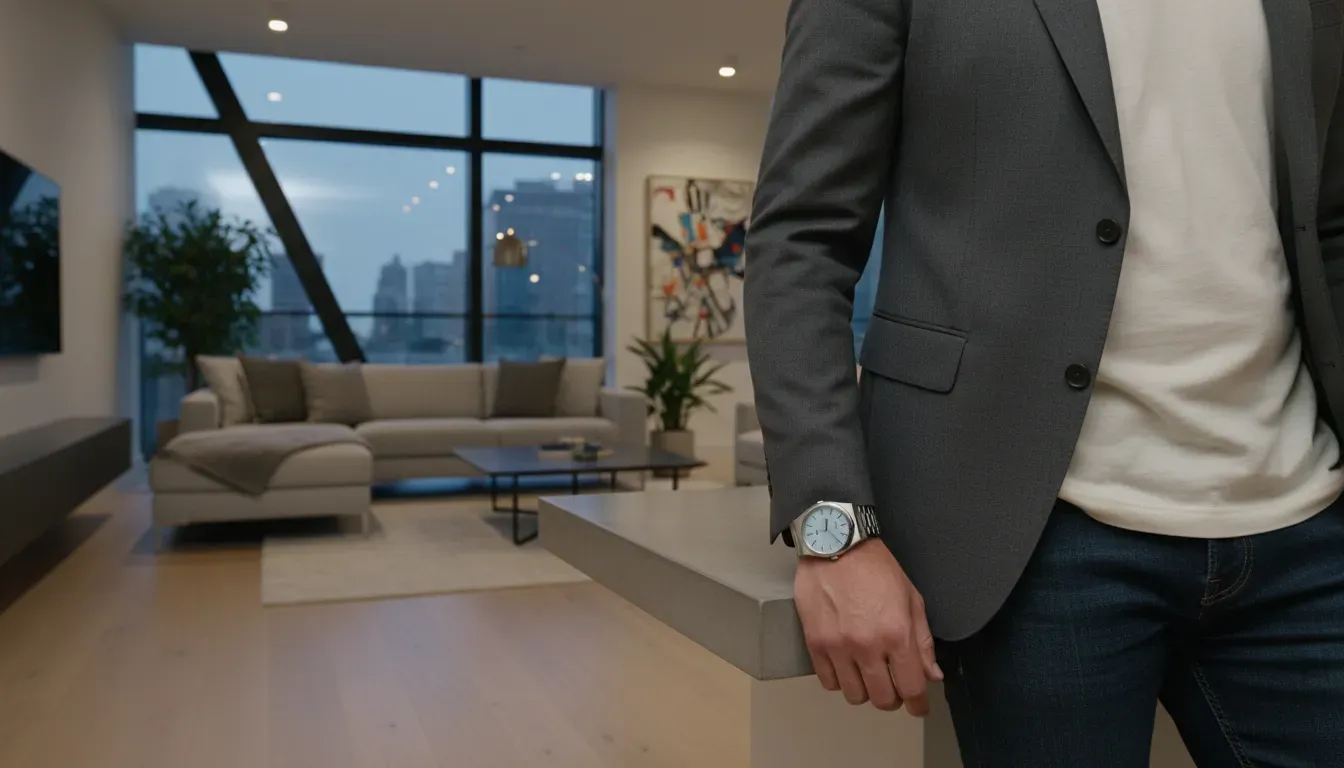
Tissot listened. They released the 35mm version, first in quartz, then in automatic. This responsiveness is rare in the Swiss watch industry, which is notoriously slow and stubborn. By offering the 35mm, they unlocked the unisex market and appeased the vintage purists who believe a gold dress watch shouldn’t look like a dinner plate on the wrist.
Keeping these high-polish surfaces pristine is a challenge, though. The flat surfaces are magnets for fingerprints and micro-scratches. Every owner eventually invests in a Professional Watch Cleaning Kit to keep that disco-ball shine active.
Is It Still King?
Years after its release, has the hype died? A little, naturally. But the PRX has transitioned from “hype watch” to “modern staple.”
It has effectively killed the grey market for many entry-level luxury pieces. Why buy a used, beat-up 90s Tag Heuer when you can get a brand new PRX with a warranty and better finishing?
The Tissot PRX case study proves that you don’t need to reinvent the wheel. You just need to look at what the people are starving for, look at what you already have in your history, and execute it with a level of quality that makes the price tag look like a mistake.
The integrated bracelet trend is here to stay, and while the Royal Oak started the fire in 1972, the PRX poured gasoline on it for the rest of us.