How to Spot a Fake Luxury Watch: A Buyer's Survival Guide
Master the art of watch authentication. Learn the critical tells, from movement mechanics to dial details, before you buy on the secondary market.
Feb 10, 2026 - Written by: Brahim amzil
How to Spot a Fake Luxury Watch: A Buyer’s Survival Guide
There is a specific kind of anxiety that comes with buying a luxury watch on the secondary market. You’ve saved the money, you’ve hunted down that specific Omega Speedmaster or Rolex Submariner, and now you’re staring at a listing. The photos look good. The price is… tempting. Maybe a little too tempting.
Here is the hard truth: The counterfeit watch market is a multi-billion dollar industry. We aren’t just talking about the $50 knock-offs sold on beach towels in tourist traps anymore. We are dealing with “Super Clones”—replicas so sophisticated they can fool even seasoned pawn shop owners. These fakes use real ceramic, decent steel, and cloned movements that mimic the beat rate of the genuine article.
But they aren’t perfect. They never are.
If you are going to play in the grey market sandbox, you need to know how to inspect a timepiece like a forensic analyst. You need to look past the shine and see the flaws. This guide isn’t just about avoiding a rip-off; it’s about understanding what makes a luxury watch truly “luxury” in the first place.
The First Impression: Weight and Finish
Pick it up. Before you even look at the logo, let your hand do the thinking.
Luxury watches are dense. Whether it’s 316L stainless steel, 904L steel (which Rolex uses), platinum, or gold, genuine metals have specific mass. Counterfeiters often use lighter, cheaper alloys to cut costs. If you pick up a gold President Day-Date and it feels like a toy, put it down. It’s fake.
However, weight can be faked with lead spacers, so you can’t stop there. You need to look at the finishing.
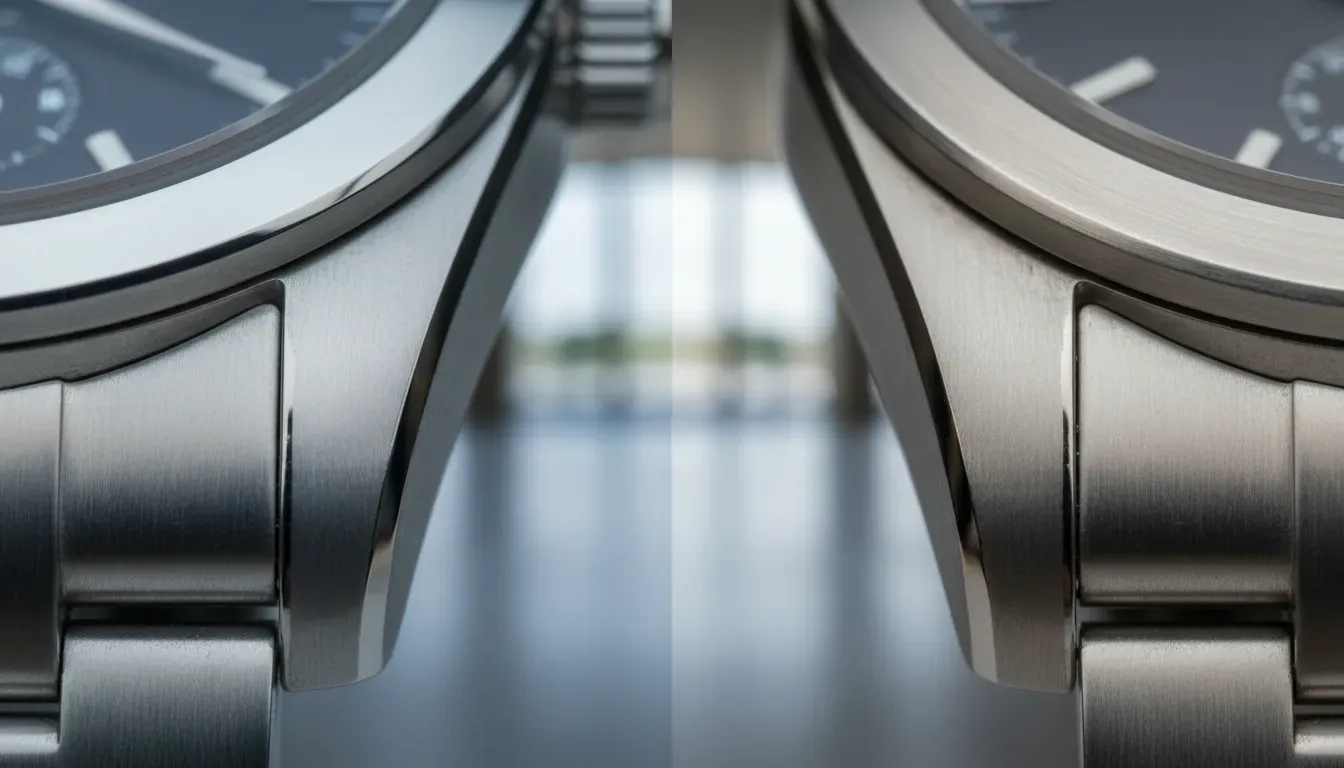
High-end horology is about the interplay of light. A genuine case will often have contrasting finishes—brushed surfaces meeting polished bevels with razor-sharp transitions. On a fake, these transition lines are often muddy or rounded. Run your finger along the edge of the case or the lugs. Is it sharp? Is it uniform?
A genuine luxury watch feels “soft” to the touch, not because the metal is soft, but because the machining is so precise there are no burrs or rough edges. If the bracelet pulls your arm hair or feels like a cheese grater against your wrist, you’re likely holding a replica.
The Dial: Where the Devil Lives
The dial is the face of the watch, and it’s usually where counterfeiters make their most microscopic mistakes. To the naked eye, a Super Clone dial looks immaculate. But under magnification, the façade crumbles.
You need to get up close. I highly recommend picking up a Jarlink 30X 60X Illuminated Jewelers Eye Loupe. It’s an inexpensive tool that can save you thousands of dollars.
Typography and Spacing
Look at the text. On a Patek Philippe or a Rolex, the font is applied with ink that has volume. It stands up off the dial slightly. The edges of the letters should be crisp and clean.
On fakes, the printing is often flat. Under your loupe, you might see “bleeding,” where the ink has seeped slightly into the grain of the dial. Look for misspellings (it happens more often than you think) or inconsistent spacing between letters. The “kerning”—the space between characters—is mathematically perfect on a Swiss timepiece. On a fake, the “R” and “O” might be just a hair too close together.
The Lume Application
Luminescence (the stuff that glows in the dark) is difficult to apply evenly. Genuine brands use Super-LumiNova or Chromalight. It is applied flat, even, and fills the indices perfectly.
In counterfeit watches, the lume often looks like it was painted on with a shaky hand. You might see spillover on the edges of the hour markers, or the lume plot might look “domed” and lumpy rather than flat. Shine a UV light on it. Genuine lume charges quickly and glows brightly and uniformly. Fakes often have patchy glows or fade within seconds.
If you are getting serious about your collection, read our deep dive on Understanding Lume Technology to see how different brands handle night visibility.
The Movement: The Heartbeat
If the seller allows it, opening the case back is the ultimate test. But you don’t always need to crack the watch open to spot a fake. You just need to listen and watch.
The Sweep
Mechanical movements in luxury watches beat at high frequencies—usually 28,800 vibrations per hour (vph). This creates the illusion of a sweeping second hand.
Cheap fakes use quartz movements where the second hand ticks once per second. That’s an immediate giveaway (unless, of course, you are buying an Oysterquartz or a specific quartz Omega).
However, better fakes use automatic movements. But they aren’t good automatic movements. Watch the second hand closely. Does it stutter? Does it jitter as it sweeps around the dial? A well-serviced Rolex or AP movement has a sweep that is buttery smooth.
The Sound
Hold the watch to your ear. A high-quality Swiss movement ticks rapidly and quietly. It’s a fast, metallic heartbeat. Cheap movements are loud. If you can hear the watch ticking from across the room, or if the movement sounds like a clunky hollow echo, be very suspicious.
The Crystal and the Cyclops
The glass covering the dial tells a story. High-end watches almost exclusively use sapphire crystal, which is incredibly scratch-resistant. Fakes often use mineral glass.
Here is a quick field test: Place a droplet of water on the crystal. On sapphire, the water will bead up and hold its shape due to surface tension. On mineral glass, the water tends to disperse and flatten out.
The Rolex Cyclops
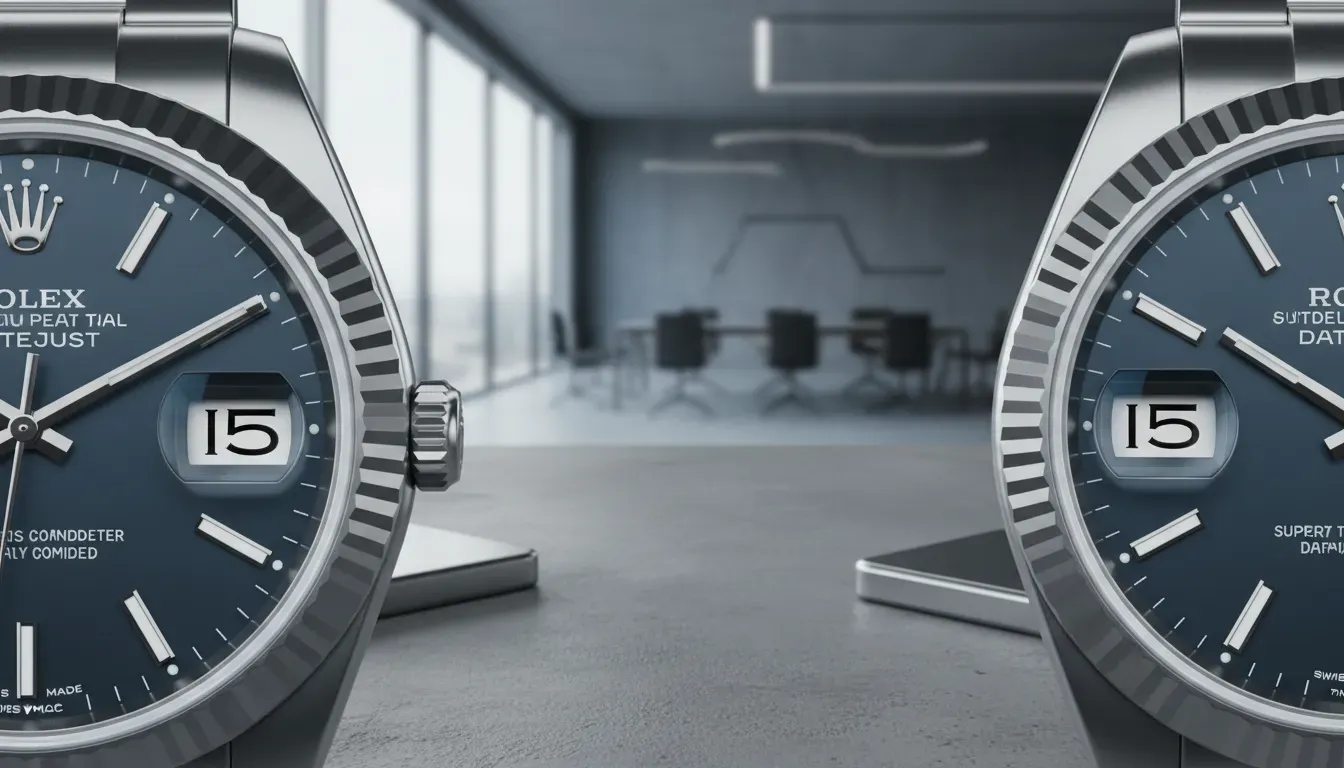
If you are looking at a Rolex Datejust or Submariner, check the “Cyclops” (the date magnifier). Genuine Rolex magnification is exactly 2.5x. The date should fill the window and pop with clarity.
Counterfeiters struggle with this. Often, the magnification is only 1.5x, making the date look small and distant. Furthermore, legitimate Rolex crystals have an anti-reflective coating only under the Cyclops (on modern models), not on the whole crystal. If the date is hard to read because of glare, walk away.
Engravings and Serial Numbers
Luxury brands don’t just stamp numbers on metal; they etch them with precision.
Check the serial number between the lugs or on the rehaut (the inner metal ring around the dial). On a real watch, these numbers are diamond-cut or laser-etched to a consistent depth. They sparkle under light. On a fake, they often look “sandy” or like they were acid-etched, lacking that clean, sharp depth.
For accurate measurement of case thickness and lug width (which must match the official manufacturing specs exactly), don’t rely on a ruler. Use a Mitutoyo 500-196-30 Advanced Onsite Sensor Absolute Scale Digital Caliper. If the spec sheet says the watch is 12.5mm thick and your caliper reads 14mm, you are looking at a fake movement that required a thicker case housing.
The Bracelet and Clasp
This is often the “tell” for mid-tier fakes. Making a bracelet that feels like liquid metal is expensive.
Hold the watch by the case and let the bracelet hang. Give it a gentle shake. Does it squeak? Does it rattle like a tin can? High-end bracelets have very tight tolerances. There should be minimal side-to-side play (stretch) unless the watch is very old.
Inspect the clasp. This is a complex mechanical part. It should click shut with a satisfying, secure snap. It shouldn’t require force, nor should it feel loose. Open the clasp and look at the “blades” (the folding metal parts). The engravings here should be deep and polished. Fakes often have shallow laser etching that looks dark or burnt.
Box and Papers: The False Security
Do not—I repeat—do not assume a watch is real just because it comes with a box and warranty card.
It is actually easier to fake a cardboard box and a plastic card than it is to fake a complex mechanical timepiece. I have seen impeccable boxes paired with terrible watches.
Check the documentation for print quality. Are the colors bleeding? Is the cardstock flimsy? Use an Alonefire SV003 10W UV Flashlight 365nm to inspect the papers. Many modern guarantee cards (especially newer Rolex and Omega cards) have UV details hidden on them. If the card doesn’t react to UV light, or if the pattern is wrong, the papers are trash, and the watch likely is too.
Buy the Seller, Not the Watch
You can memorize every font weight and case dimension in the world, but the single best defense against fraud is vetting the person taking your money.
A reputable dealer has a reputation to lose. A random guy on a forum or Craigslist does not. Look for sellers with long track records, verified reviews on independent platforms, and a clear return policy. Ask for references. If a seller gets defensive when you ask for more photos or proof of identity, that is a massive red flag.
Real sellers want you to feel comfortable. They will jump on a video call. They will set the watch to a specific time you request to prove they have it in hand. They will verify the movement.
When to Call the Pros
If you are spending amount of money that would hurt to lose, you need third-party authentication.
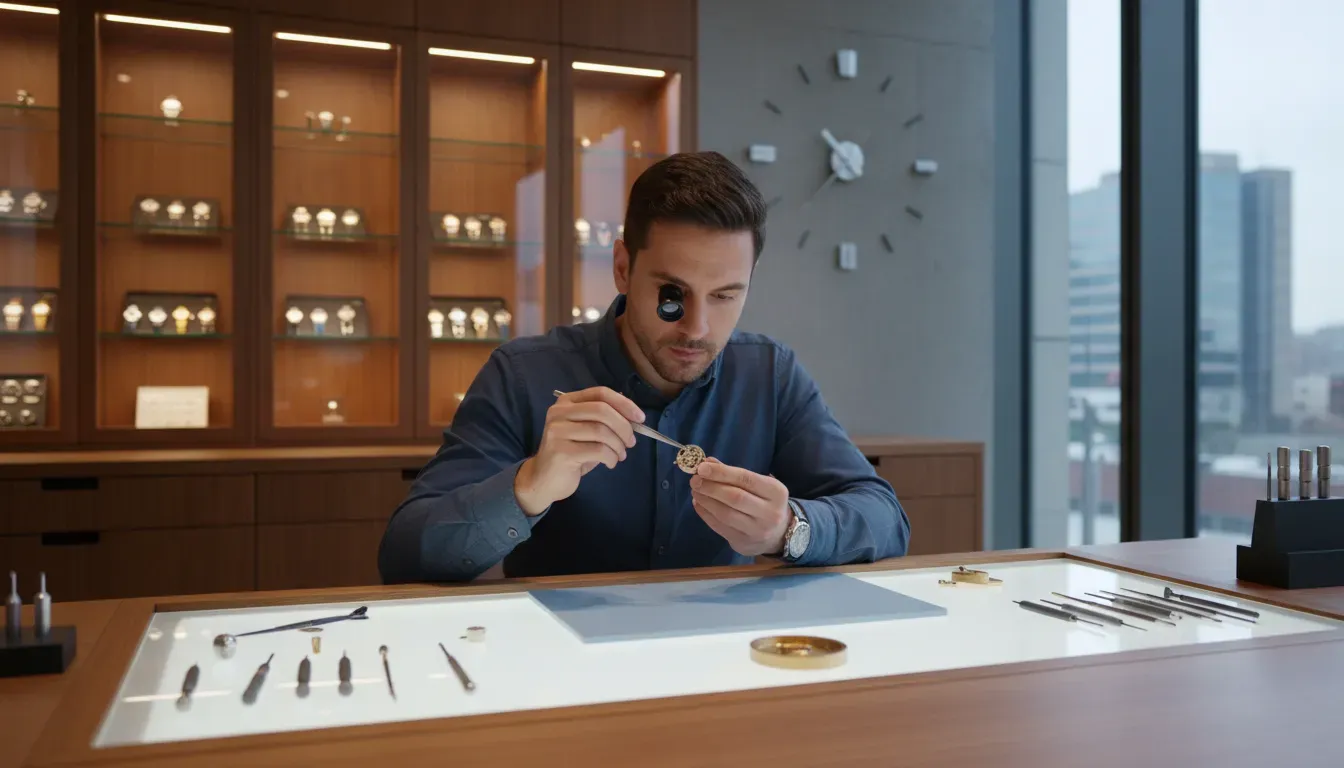
There are services where the watch is shipped to a center, inspected by professional watchmakers, and then sent to you. eBay has an Authenticity Guarantee program, and sites like Chrono24 offer escrow services. For direct deals, suggest meeting at a certified watchmaker to have the case back opened.
If the seller refuses to meet at a jeweler? You have your answer.
Final Thoughts: Trust Your Gut
The oldest cliché in the book exists because it’s true: If it sounds too good to be true, it is.
You are not going to find a $10,000 Submariner for $3,000 because the seller “doesn’t know what they have.” In the age of the internet, everyone knows what they have. Low prices are the bait used to hook buyers who let greed override their logic.
Educate yourself. Use the right tools. Ask the hard questions. The hunt for a luxury timepiece is thrilling, but the victory only counts if the watch on your wrist is the real deal. Stay sharp, and happy hunting.