Investment Guide: Do Entry-Level Luxury Watches Hold Value?
An honest, data-driven look at whether brands like Hamilton, Oris, and Tudor are safe places to park your money or if they are purely expenses.
Feb 11, 2026 - Written by: Brahim amzil
Let’s rip the band-aid off right now. If you are buying a watch in the $500 to $3,500 range expecting it to perform like an S&P 500 index fund, you are setting yourself up for disappointment.
We live in a strange era of horology. Social media algorithms feed us endless clips of crypto-bros flexing Patek Philippes and talking about “asset classes.” This has distorted the reality for the average enthusiast. The truth? Most watches are a depreciating asset. They are machines. Like a BMW or a high-end refrigerator, they require maintenance, they get scratched, and newer models eventually replace them.
But here is where it gets nuanced. Not all watches crash in value the same way.
There is a massive difference between “making money” and “holding value.” If you buy smart, you can wear a beautiful piece of mechanical art for three years and sell it for nearly what you paid. That’s a win. To navigate this, we need to look at the “Entry-Level Luxury” tier—specifically brands like Hamilton, Oris, and Tudor—to understand the real economics of wristwear.
The “Drive-Off-The-Lot” Phenomenon
The moment you swipe your credit card at an authorized dealer (AD) for a brand-new watch, you usually lose 20% to 40% of its value. Poof. Gone.
This isn’t a conspiracy; it’s just math. That margin covers the dealer’s overhead, the sales commission, the marketing budget, and the Value Added Tax (VAT) or sales tax. The secondary market—where the true value of a watch lives—doesn’t care about the boutique’s rent. It only cares about the demand for the metal on your wrist.
However, depreciation curves aren’t linear. They usually look like a steep cliff followed by a long, flat plateau. The trick to “investing” in this segment isn’t about finding a unicorn that doubles in price; it’s about buying at the bottom of the cliff or choosing a brand where the cliff is a gentle slope.
Case Study 1: Hamilton and the Volume Game
Hamilton is the gateway drug for many collectors. They offer incredible heritage, Swiss reliability (under the Swatch Group umbrella), and designs that just work. But do they hold value?
Generally speaking, no. Not in the traditional sense.
Hamilton operates on a high-volume model. You can walk into almost any mall or department store and find a Hamilton Khaki Field Mechanical. Because supply is abundant, the secondary market is never starved. If you buy a Khaki Field new for $575, do not expect to sell it for $600 next year. You will likely get $350 to $400.
The Silver Lining
While they drop, they hit the floor fast and stay there. A used Hamilton Khaki Field has been trading around that $350 mark for years. It’s a stable currency. If you buy one pre-owned, you can essentially “rent” it for free. You buy it for $350, wear it for a year, and sell it for $350.
The Verdict: Buy Hamiltons pre-owned or purely for the love of the design. They are fantastic watches, but they are expenses, not investments.
Case Study 2: Oris and the Independent’s Struggle
Oris occupies a fascinating space. They are one of the few independent Swiss brands left in this price bracket. They make “real watches for real people.” Their build quality often punches way above their weight class, often rivaling brands that cost twice as much.
So, how does the market treat them?
It’s a mixed bag. Oris suffers from what I call “retail softness.” Because they lack the massive marketing machine of a Rolex or Omega, and because they are available at many retailers who are willing to offer discounts, the “street price” is often significantly lower than the MSRP.
If the sticker price on an Aquis is $2,400, but you can find it on the gray market for $1,600, the used value is going to be anchored to that lower number. Expect an Oris to lose about 40-50% of its MSRP on the secondary market.
The Aquis Exception
The Oris Aquis Date is their flagship. It has high liquidity. This means that while you will lose money selling it, you can sell it quickly. There is always a buyer for an Aquis.
Compare this to a niche model from a micro-brand where you might wait six months to find a buyer. Oris offers liquidity, which is a form of value in itself.
The Verdict: Oris is a “buy to keep” brand. If you must sell, you will take a hit unless you bought it at a steep discount to begin with.
Case Study 3: Tudor and the Rolex Halo
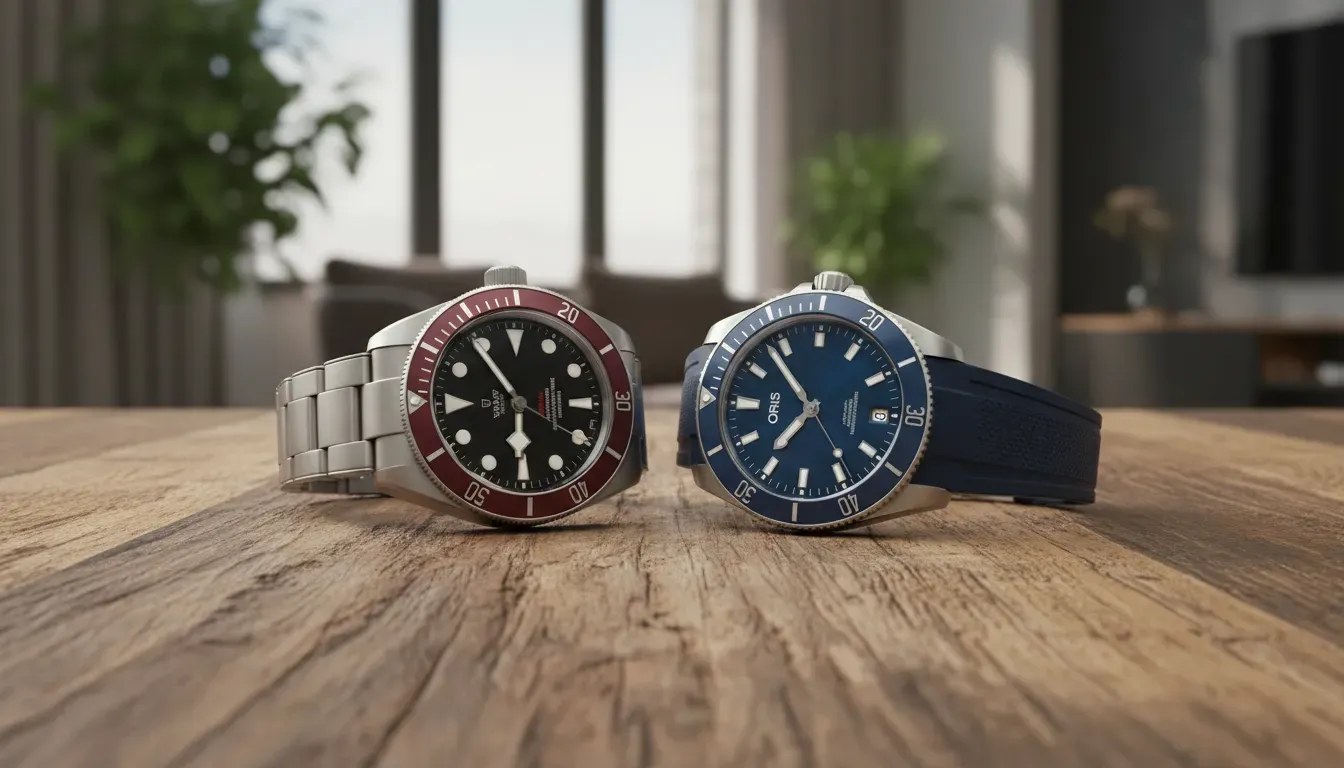
Now we enter the heavyweight division of “entry-level” luxury. Tudor is the sibling company of Rolex. For decades, they were the “poor man’s Rolex,” but in the last ten years, they have forged their own identity—bold, vintage-inspired, and incredibly well-made.
Tudor is the anomaly in this list.
Because you generally cannot walk into a store and buy a steel Rolex sports watch without a multi-year waitlist, the spillover demand hits Tudor. The Black Bay 58 and the Pelagos are the beneficiaries of this frustration.
The Retention Reality
Tudor watches hold their value significantly better than Hamilton or Oris. A Black Bay 58 purchased at retail (around $3,800 depending on the strap) might trade used for $3,000 to $3,300. That is a retention rate of nearly 80-85%.
For a brief period during the watch market hype of 2021-2022, some Tudors were actually selling over retail. Those days are largely gone. The market has corrected. We are back to normal depreciation, but the curve is very shallow.
The Verdict: Tudor is the safest place to park money in this bracket. You likely won’t make a profit, but your “cost of ownership” will be very low.
The “In-House” Movement Trap
You will hear sales associates wax poetic about “in-house movements.” This means the brand built the engine themselves rather than buying a generic one from a supplier like ETA or Sellita.
From a collector’s standpoint, in-house is cool. It shows engineering prowess. From a value standpoint? It’s a double-edged sword.
Generic movements are cheap to service. Any watchmaker in any city can fix an ETA 2824 movement for a few hundred bucks. An in-house caliber from Oris or Tudor usually needs to go back to the factory. That service bill might be $500 to $800.
When you are looking at a watch worth $2,000, a $800 service bill is a massive chunk of equity. Smart buyers on the secondary market factor this in. Sometimes, the older models with generic movements actually hold value better because they are cheaper to keep running.
Consider the Tissot PRX Powermatic 80. It uses a modified generic movement. It’s reliable, cheap to fix, and holds a decent percentage of its low entry price simply because it’s the hottest design in the affordables market right now.
Strategies to “Hack” the Value Curve
If you love watches but hate burning money, you have to change how you buy. You can’t just be a consumer; you have to be a strategist.
1. The “Like New” Sweet Spot
Let someone else take the initial hit. Look for listings described as “LNIB” (Like New In Box). These are watches bought by enthusiasts who wore them twice, decided they didn’t bond with them, and are selling them three months later. You get a virtually new watch with the warranty card still valid, for 20% off.
2. Full Kit or Bust
“Watch only” listings are cheaper for a reason. If you ever plan to resell, you need the box and papers. In the luxury world, provenance is everything. A full kit validates authenticity and shows the previous owner cared. A watch without a warranty card is like a car without a title—hard to move.
For more on protecting yourself during these transactions, check out our guide on How to Spot a Fake Watch.
3. Limited Editions (with a Grain of Salt)
Brands love to slap “Limited Edition” on a dial color change. Be careful here. True limited runs (numbered out of 1,000 or less) from brands like Oris can sometimes appreciate, or at least depreciate slower. But don’t fall for “Special Editions” which are produced in the thousands for years. That’s just marketing fluff.
The Hidden Costs: Selling Isn’t Free
Here is the part nobody talks about in “investment” guides. Selling a watch costs money.
If you sell on eBay, they take roughly 13-15% in fees. If you sell on Chrono24, there are fees. If you use PayPal, there are transaction fees. Then there is insured shipping, which for a $3,000 item is not cheap.
Let’s say you bought a Tudor for $3,500 and it “held its value” at $3,500.
- Sale Price: $3,500
- Platform Fee (13%): -$455
- Shipping/Ins: -$50
- Net to you: $2,995
You lost $500 despite the watch “holding its value.” The friction of the market eats your margins. This is why flipping entry-level luxury watches for profit is almost impossible unless you are a dealer buying at wholesale prices.
Final Verdict: Buy What Makes You Smile
We need to redefine what “Investment” means in this context.
Are entry-level luxury watches a financial investment? No. Are they an investment in your personal style and enjoyment? Absolutely.
If you buy a Hamilton Khaki Field, wear it on your wedding day, take it on hiking trips, and scratch the bezel while fixing your first home, that watch has accrued value that a spreadsheet cannot capture.
The best strategy is to buy the watch you can’t stop thinking about. If it’s a Tudor, great—you have a financial safety net. If it’s an Oris, great—you have a unique piece of engineering. Just don’t treat your watch box like a stock portfolio. It’s meant to tell time, not your net worth.