Oris: A Case Study in Independent Watchmaking Value
Discover how Oris delivers unmatched value through independence, a look at affordable automotive chronographs, and the Rolex vs. Tudor debate.

Oris maintains its status as a high-value leader in Swiss horology by remaining fiercely independent, free from the pricing structures and shareholder demands of large luxury conglomerates like Swatch Group or Richemont. This independence allows the Hölstein-based brand to invest heavily in proprietary technology—such as the 10-year warranty Calibre 400—while keeping price points attainable for enthusiasts. By focusing exclusively on mechanical movements and listening directly to their collector base, Oris bridges the gap between utilitarian tool watches and high-end luxury, particularly evident in flagship lines like the Aquis and Big Crown Pointer Date.
The Holstein Way: Independence as a Business Model
In a world where almost every historic Swiss dial name is owned by a handful of corporate giants, Oris stands alone. Since 1904, they have been doing things their way in the village of Hölstein. Why does this matter to the consumer? Because when you strip away the massive corporate overhead, the marketing departments that cost more than the R&D labs, and the need to position a brand specifically so it doesn’t cannibalize a sister company’s sales, you get a pure product.
Oris doesn’t have to worry if their diver is “too good” and might hurt sales of an Omega Seamaster or a Blancpain Fifty Fathoms. They just make the best watch they can.
This freedom has culminated recently in the “Calibre 400” series. For decades, Oris relied on reliable, third-party Sellita movements. They were great, easy to service, and kept costs down. But Oris wanted more. They developed an in-house movement with a five-day power reserve, high anti-magnetism, and a recommended service interval of 10 years. That is unheard of at their price point.
The Aquis: Defining the Modern Diver
If you look at the saturation of the dive watch market, it is almost impossible to stand out. Yet, the Oris Aquis has become a staple. It is arguably the best “dollar-for-dollar” diver on the market today.
The Aquis doesn’t try to be a vintage reissue. It isn’t leaning on faux-patina lume or scratching an itch for nostalgia. It is a thoroughly modern, robust piece of engineering. The integrated bracelet lugs give it a distinct silhouette that feels solid on the wrist, though it does make strap changes a bit proprietary.
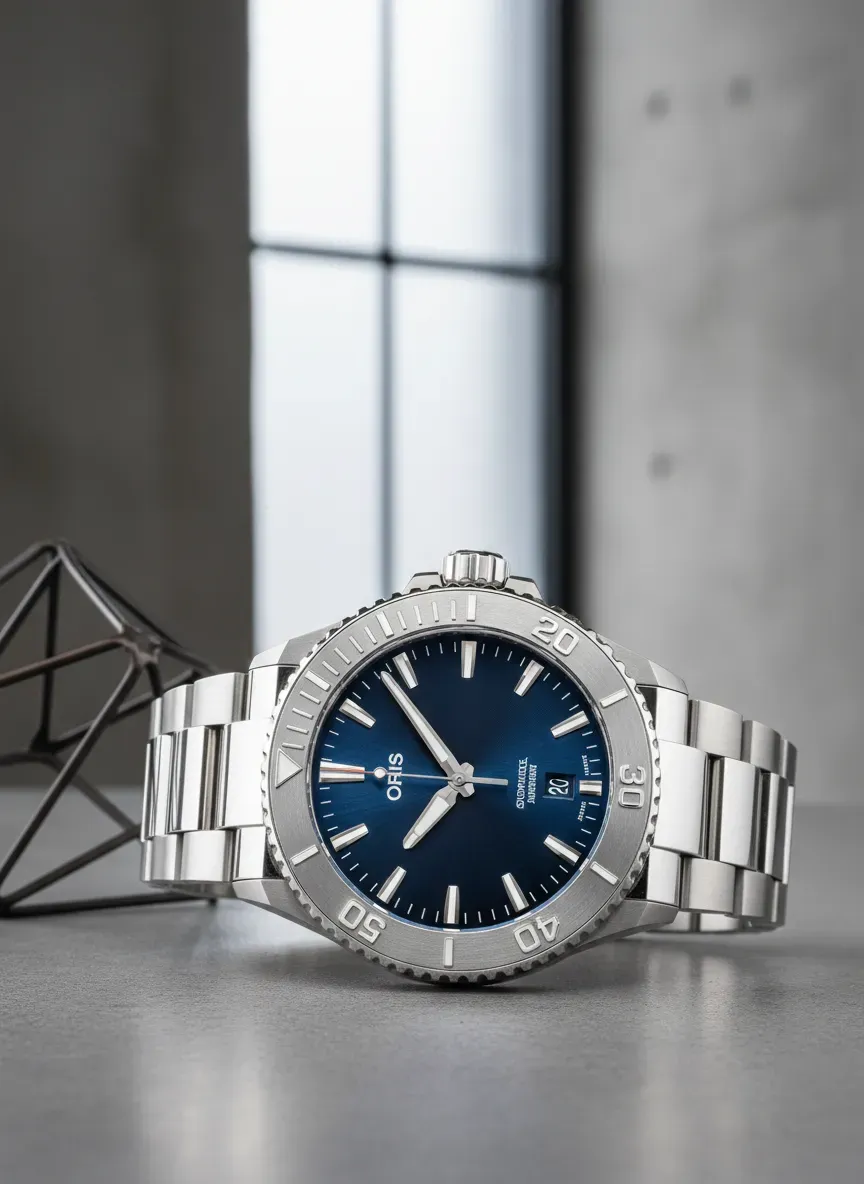
With the introduction of the Calibre 400 into the Aquis line, Oris effectively threw down the gauntlet. They offered specs that rival watches costing three times as much. You get a ceramic bezel, sapphire crystal, 300 meters of water resistance, and a movement that you don’t have to wind for almost a week. It’s a compelling package that many of the big groups struggle to match because they need to protect their tiered pricing structures.
The Big Crown: A Pilot’s Legacy
On the other side of the spectrum is the Big Crown Pointer Date. This is Oris embracing its history without being trapped by it. First introduced in 1938, the oversized crown was a functional necessity for pilots wearing thick leather gloves in unpressurized cockpits.
Today, it serves as the brand’s sophisticated, vintage-inspired dress-casual option. The “Pointer Date” complication—where a fourth hand points to the date on the outer rim of the dial rather than using a date window—is an Oris signature. It keeps the dial symmetrical and clean.
What makes the Big Crown line so interesting is the variety. You can find them in bronze, which patinas uniquely to every owner, or in steel with colorful dials ranging from oxblood red to slate blue. It’s a masterclass in how an independent brand can iterate on a design faster than a conglomerate can approve a marketing brief.
For those looking to step outside the usual suspects of the watch world, Oris is often the first stop. However, if you are looking to broaden your horizon even further, you should check out our guide to 7 Underrated Luxury Brands that offer similar value propositions.
Speed and Steel: Affordable Luxury Chronographs
Shifting gears from the independent spirit of Oris, we land squarely on the racetrack. The chronograph is one of the most romanticized complications in watchmaking. It is tactile. It requires interaction. And historically, it is tied to the smell of gasoline and burning rubber.
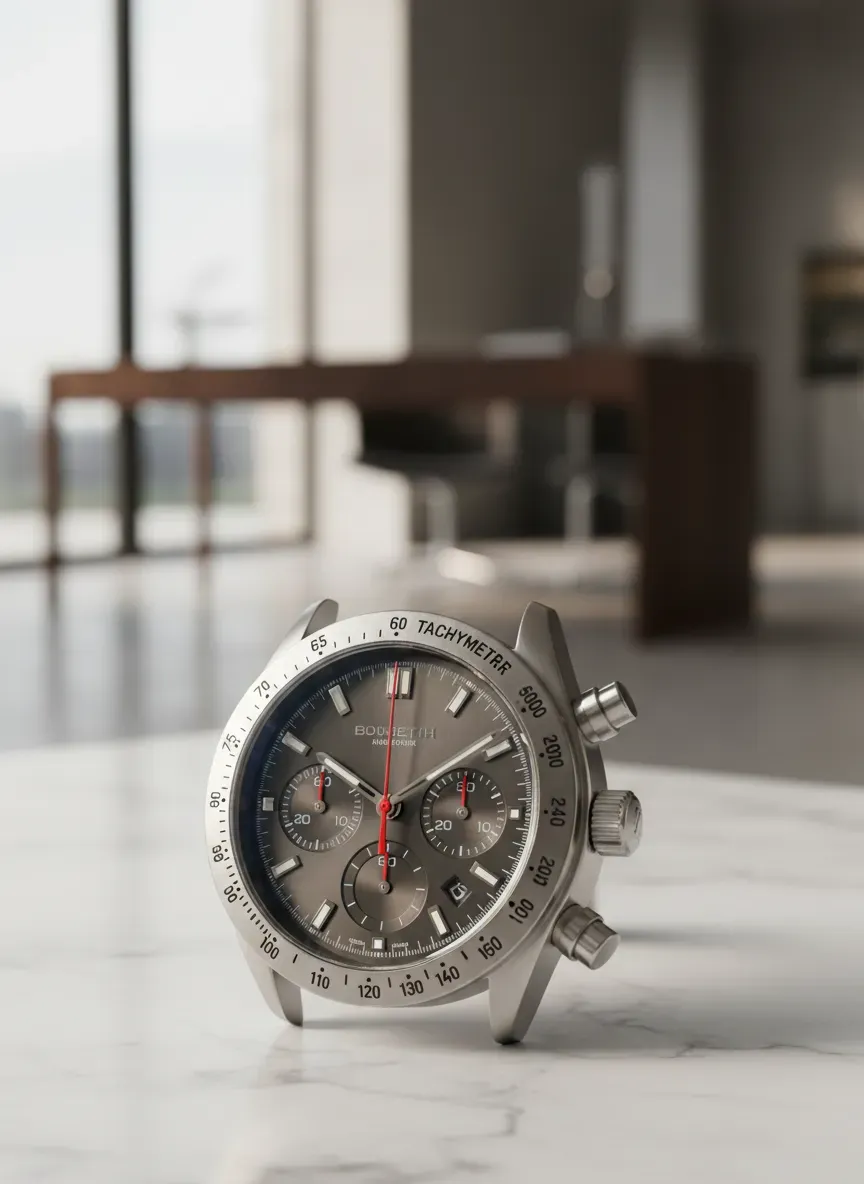
A chronograph is essentially a stopwatch worn on the wrist, but the addition of a tachymeter scale on the bezel transforms it into a computing device. By starting the chronograph at a mile marker and stopping it at the next, the second hand points to your average speed in miles per hour on the tachymeter scale. It’s old-school tech, but it’s undeniably cool.
Here are three affordable luxury chronographs that capture that automotive spirit without the Daytona waitlist.
1. The American Muscle: Hamilton Intra-Matic Auto Chrono
Hamilton brings serious American heritage to the table, combined with Swiss precision. The Intra-Matic is a nod to the golden era of racing in the late 60s. The “Panda” dial configuration (white dial, black sub-dials) is iconic for legibility at high speeds.
It runs on the H-31 exclusive movement, which offers a robust 60-hour power reserve. This watch screams vintage racing. It feels like it belongs on the wrist of a driver gripping a wooden steering wheel in a Trans-Am race.
Hamilton Intra-Matic Auto Chrono
2. The Lunar Racer: Bulova Lunar Pilot
While famous for going to the moon, the Bulova Lunar Pilot has a high-performance quartz movement that vibrates at 262 kHz. Why does this matter for racing? Precision. The chronograph function is incredibly accurate, and the sweep of the second hand is smoother than many mechanical watches.
The tachymeter scale is legible, and the pushers are unique—long and flat, designed originally for astronaut gloves, but they work just as well for driving gloves. It is a large watch, commanding presence and offering a history lesson on the wrist for a fraction of the price of mechanical Swiss chronographs.
Bulova Lunar Pilot Chronograph
3. The Swiss Entry: Tissot PRX Automatic Chronograph
Tissot has been killing it lately, and the PRX Chronograph is their victory lap. With an integrated bracelet design straight out of the 1970s, this watch offers a Valjoux-based movement architecture at a price that seems like a mistake. The finishing is sharp, the dial has a vertical brushing that catches the light, and the pushers have a satisfying mechanical click.
It’s heavy, it’s steel, and it feels expensive. For anyone looking to understand the difference between entry-level Swiss brands, seeing how Tissot stacks up against higher-tier competitors is vital. You can read more about those market battles in our analysis of TAG Heuer vs Longines, where the chronograph wars are fought at a slightly higher price bracket.
Tissot PRX Automatic Chronograph
The Crown vs. The Shield: Entry-Level Rolex vs. Modern Tudor
When discussing value in watchmaking, the conversation eventually gravitates toward the elephant in the room: Rolex. Specifically, the “entry-level” Rolex. But does that term even apply anymore?
Let’s look at the Rolex Oyster Perpetual (OP) versus its sibling equivalent, the Tudor Black Bay 36/41 (or the Ranger).
The Rolex Oyster Perpetual: The Unavailable Standard
The Oyster Perpetual is technically the cheapest way into the Rolex family. It is the essence of the brand: an Oyster case, a waterproof crown, and a self-winding Perpetual movement. It is perfection in simplicity.
However, “cheap” is relative. The retail price is accessible for a luxury item, but the availability is non-existent. You cannot simply walk into a boutique and buy an OP with a green or Tiffany-blue dial. You play the game, or you pay the grey market premium, which often doubles the price.
At that point, the value proposition crumbles. You aren’t paying for the steel and the movement; you are paying for the hype and the crown on the dial.
The Tudor Black Bay: The Vintage Soul
Enter Tudor. Hans Wilsdorf founded Tudor to be the attainable sibling to Rolex, offering the same dependability at a lower price point by using third-party movements (historically). Today, Tudor has evolved. They now use in-house (Kenissi) movements that are COSC certified, robust, and technologically impressive.
The Tudor Black Bay 31/36/39/41 range is the direct competitor to the Rolex OP.
- Build Quality: It is 90-95% of the Rolex quality. The steel is 316L (standard high-grade) versus Rolex’s 904L (harder, shinier, but more prone to scratches).
- Availability: You can actually buy one.
- Aesthetic: Tudor leans into the vintage tool-watch vibe that Rolex abandoned in favor of jewelry-like luxury.
If you compare a Tudor Ranger to a Rolex Explorer, or a Black Bay 36 to an Oyster Perpetual, the Tudor feels like the watch Rolex was making in the 1960s—pure, rugged, and ready for abuse. The Rolex feels like a piece of jewelry that can handle abuse, but you’d be terrified to scratch it.
The Verdict on Value
If you have $6,000 to spend, you could struggle to find a Rolex OP, or you could buy a Tudor Black Bay, a nice dinner, and maybe even a weekend trip. Or, bringing it full circle, you could buy an Oris Aquis Calibre 400 and have a movement with a 10-year warranty that rivals both.
The market for entry-level luxury is fierce. For a broader look at where to put your money if you are just starting your collection, check out our list of the Top 10 Entry-Level Luxury Watches.
Final Thoughts
The landscape of watch collecting is shifting. The big groups will always have their place, and the Crown will always be King. But the real excitement, the real horological passion, is found in the independents like Oris who are hungry to prove themselves, and in the “little siblings” like Tudor who are tired of living in the shadow. Whether it’s the 10-year warranty of an Oris or the racing heritage of a Hamilton, value is out there—you just have to look past the hype to find it.