Quartz vs. Automatic: Which Movement Suits Your Lifestyle?
Confused by watch movements? We break down the technical differences between quartz and automatic to help you choose the right timepiece for your daily life.
Feb 10, 2026 - Written by: Brahim amzil
Quartz vs. Automatic: Which Movement Suits Your Lifestyle?
Buying your first “serious” watch is a rite of passage. It’s that moment you decide to stop glancing at your phone for the time and start wearing a piece of engineering on your wrist. But then you hit the wall of jargon. You’re staring at two watches that look nearly identical on the surface. One costs $300, and the other costs $1,500. One says “Quartz,” the other “Automatic.”
What gives?
Here is the reality: you aren’t just buying a way to tell time. You are buying an engine. And just like choosing between an electric vehicle and a vintage V8 muscle car, the choice between quartz and automatic isn’t about which one is “better” in a vacuum. It is about which one fits how you actually live.
If you are a new collector, the industry marketing can be suffocating. They will tell you mechanical watches have “soul” and quartz watches are “soulless appliances.” That is a massive oversimplification. We are going to strip away the romance for a second and look at the cold, hard mechanics. By the end of this, you’ll know exactly which engine belongs on your wrist.
The Heart of the Matter: Technical Breakdown
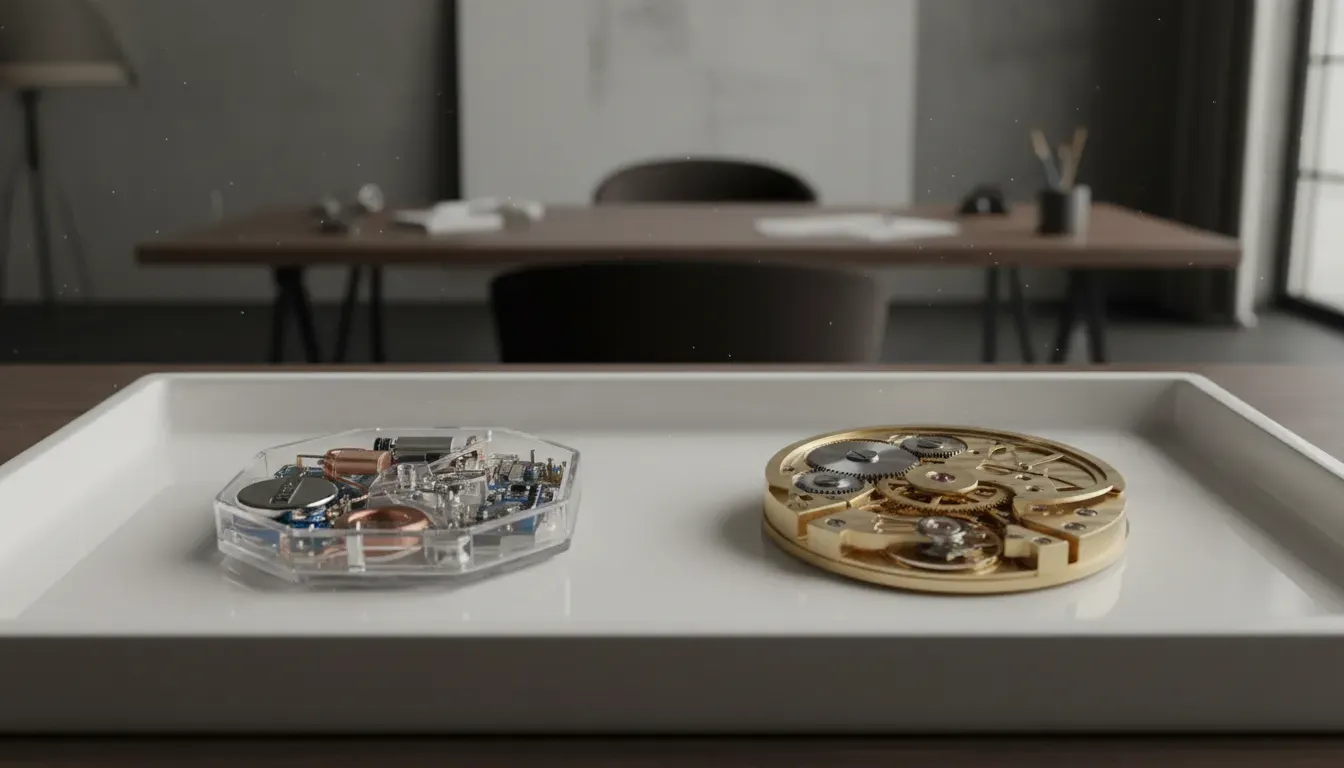
To make an informed choice, you have to understand what is happening under the dial. The fundamental difference lies in two areas: the power source and the regulation.
Quartz: The Science of Vibration
When Seiko unleashed the quartz movement on the world in 1969, it nearly destroyed the Swiss watch industry. Why? Because it was relentlessly accurate and cheap to mass-produce.
Here is the physics: A battery sends an electric current through a small crystal of quartz shaped like a tuning fork. Quartz is piezoelectric—meaning when you hit it with electricity, it vibrates. And it doesn’t just wobble; it vibrates at a hyper-specific frequency of 32,768 times per second.
A microchip counts those vibrations and turns them into one electric pulse per second, which drives a stepping motor to move the second hand. That is why a quartz watch has that distinct “tick-tick-tick” motion. It chops time into perfect one-second slices.
Automatic: The Kinetic Engine
Automatic watches are a subset of mechanical watches. There are no batteries here. No chips. No electricity. It is a machine made of gears, springs, and screws.
In a standard manual-wind mechanical watch, you have to turn the crown to tighten a mainspring. As that spring unwinds, it releases energy to turn the gears.
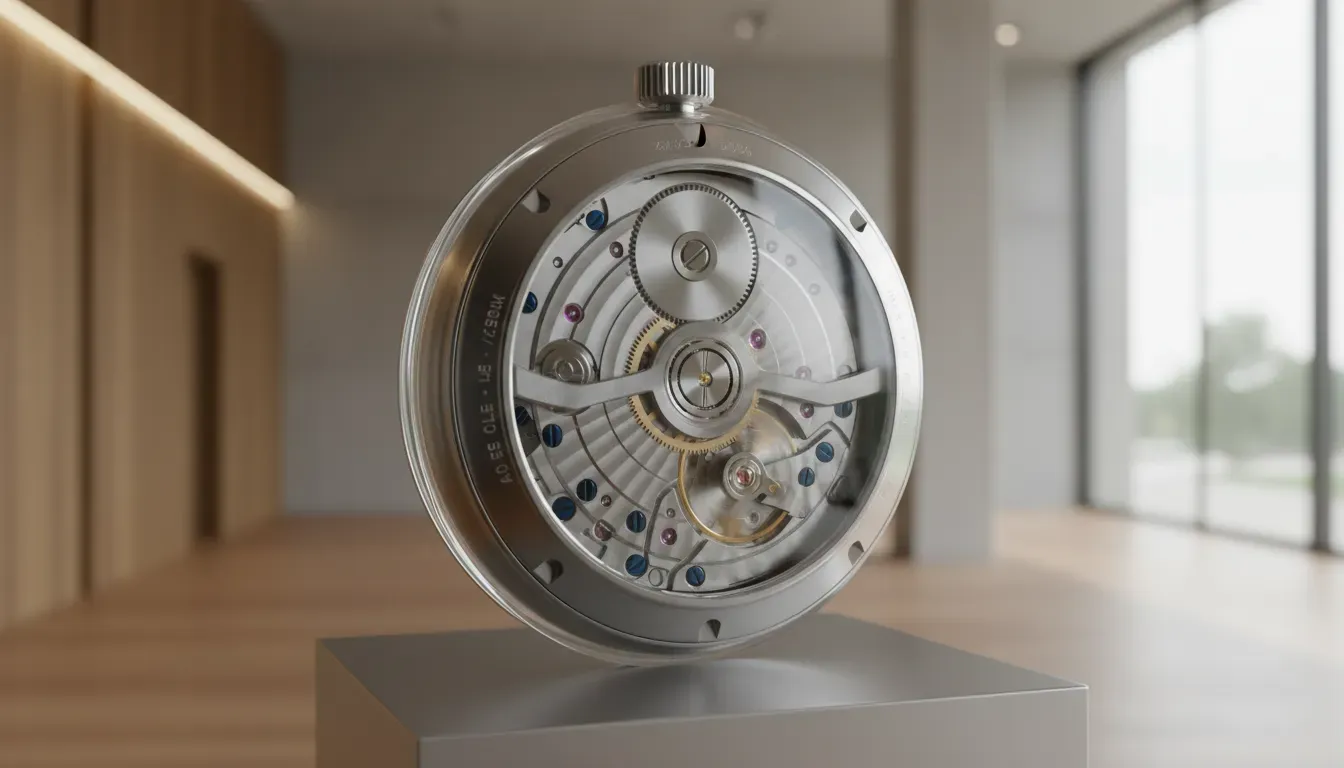
An automatic watch takes this a step further. It has a weighted semi-circular rotor attached to the back of the movement. Gravity does the work here. As you move your arm—swinging it while walking, reaching for a coffee, typing—that rotor spins. The spinning motion winds the mainspring for you.
The energy release is regulated by a balance wheel (think of it as the watch’s pendulum) and a hairspring. This happens several times a second, creating the illusion of a sweeping second hand.
The Case for Quartz: Precision and Resilience
Let’s be honest. If your primary goal is to know the exact time, every single time you look at your wrist, quartz is the undisputed king.
A standard mechanical watch might gain or lose anywhere from 5 to 15 seconds a day. A high-end chronometer might be off by 2 seconds. A standard quartz watch? It might drift by 15 seconds a month.
This accuracy makes quartz the go-to for specific lifestyles. If you are in a profession where seconds matter—healthcare, emergency services, or military—the romantic “soul” of a mechanical watch doesn’t outweigh the utility of precision.
The “Grab and Go” Factor
There is a distinct luxury in low maintenance. A quartz watch keeps running whether you wear it or not, provided the battery is alive. You can leave it in a drawer for three weeks, pick it up, and it’s still telling the right time.
For the rugged adventurer or the person who hates fussing with settings, a high-quality solar-powered quartz is often the best answer. You get the accuracy of quartz without the battery waste.
If you want a watch that can survive the apocalypse (or just a really intense weekend hiking trip), look at something like the Citizen Eco-Drive Promaster Diver. It charges from any light source and is built like a tank. It’s a tool, pure and simple.
The Allure of Automatic: Craftsmanship and Legacy
So, if quartz is more accurate and durable, why do collectors spend thousands on automatics?
Because we are fascinated by the idea of a machine that runs on us.
An automatic watch has a symbiotic relationship with its wearer. If you don’t move, it dies. There is something profoundly poetic about that. When you hold an automatic watch to your ear, you don’t hear a slow tick. You hear a rapid-fire heartbeat—usually 6 to 8 ticks per second.
The Sweeping Hand
Visually, the difference is stark. The second hand on an automatic watch glides. It sweeps around the dial in a smooth, continuous motion that feels more like the actual flow of time, rather than the chopped-up seconds of a quartz.
Heirloom Status
Electronic components eventually fail. Circuits degrade. A mechanical movement, however, is just metal physics. If a gear breaks in 50 years, a skilled watchmaker can manufacture a new gear. An automatic watch, properly maintained, can literally last for centuries. This is why you see people inheriting their grandfather’s Omega or Rolex. You rarely hear about someone inheriting a 1990s digital watch with the same reverence.
For a new collector wanting to dip their toes into this world without bankrupting themselves, the Seiko 5 Sports Automatic is legendary. It features an exhibition case back, so you can actually flip the watch over and see the rotor and gears working. It’s the perfect gateway drug into horology.
The Maintenance Reality Check
This is the part most sales associates gloss over. Owning an automatic watch is like owning a pet; owning a quartz is like owning a rock.
Quartz Maintenance:
- Battery: Change it every 2-5 years. Cost: $10-$20.
- Seals: Check water resistance when changing the battery.
- Total headache: Minimal.
Automatic Maintenance:
- Service Interval: Every 5-7 years. The oils inside the movement dry up or get gummy with friction.
- The Process: The watch is disassembled, cleaned in ultrasonic baths, re-oiled, and reassembled.
- Cost: Depending on the brand, a full service can run anywhere from $200 to $800+.
If you buy a vintage automatic chronograph, the servicing cost might actually exceed the value of the watch. You have to be prepared for this ongoing relationship. If you aren’t wearing your automatic daily, the power reserve (usually 40 hours) will run out, and it will stop. You’ll have to reset the time and date every time you put it on.
Some collectors enjoy this ritual. Others find it annoying. If you fall into the latter camp but still want the prestige of an automatic, you might need a device to keep it running while you sleep. A Wolf Heritage Watch Winder simulates the motion of your wrist, keeping the mainspring wound so your watch is ready to go whenever you are.
Which Movement Fits Your Lifestyle?
We’ve covered the tech. Now let’s look at your life. The “best” movement is the one that survives your Tuesday.
Scenario A: The “One Watch” Professional
You want one good watch to wear to the office, the gym, and dinner. You don’t want to think about it.
- Verdict: High-end Quartz or a robust Automatic Diver.
- Why: If you wear it every day, the automatic stays wound. However, if you play golf or tennis, the shock can damage a mechanical balance staff. Quartz handles impact much better.
Scenario B: The Rotation Collector
You plan to own three or four watches and switch them out depending on your outfit.
- Verdict: A mix, but be warned about Automatics.
- Why: If you have four automatic watches, three of them will always be dead. You will spend five minutes setting your watch every morning. Unless you buy winders, a quartz collection is easier to grab and go.
Scenario C: The Desk Diver / Appreciator
You work in a relatively static environment but value engineering and history. You want a conversation piece.
- Verdict: Automatic.
- Why: You aren’t risking damage to the movement, and you have the time to appreciate the sweep of the hand during a boring meeting. This is about the feel of quality.
Check out our guide on Essential Dress Watches for the Office to see how different movements play into formal wear.

The Hybrid Theory
It is worth noting that the line is blurring. Brands like Grand Seiko have developed “Spring Drive” technology—a mechanical watch regulated by an electromagnetic brake rather than a traditional escapement. It has the infinite lifespan of a mechanical watch with the accuracy of quartz.
But for the new collector, stick to the basics first.
Final Verdict
So, which is it?
Choose Quartz if:
- Precision is your god.
- You plan on being rough with the watch (impact sports, power tools).
- You want a “set it and forget it” experience.
- Your budget is tighter (generally, you get more watch for your money with quartz).
Choose Automatic if:
- You are fascinated by micro-engineering.
- You want a watch that could outlive you.
- You enjoy the daily ritual of interacting with your gear.
- You love the aesthetic of the sweeping second hand.
There is no shame in quartz. Some of the most iconic watches in history—like the Cartier Tank or certain Omega Seamasters—have quartz hearts. But there is a specific magic to strapping a mechanical engine to your wrist that requires your life and movement to function.
The right choice isn’t about what the forums say. It’s about what makes you smile when you check the time.