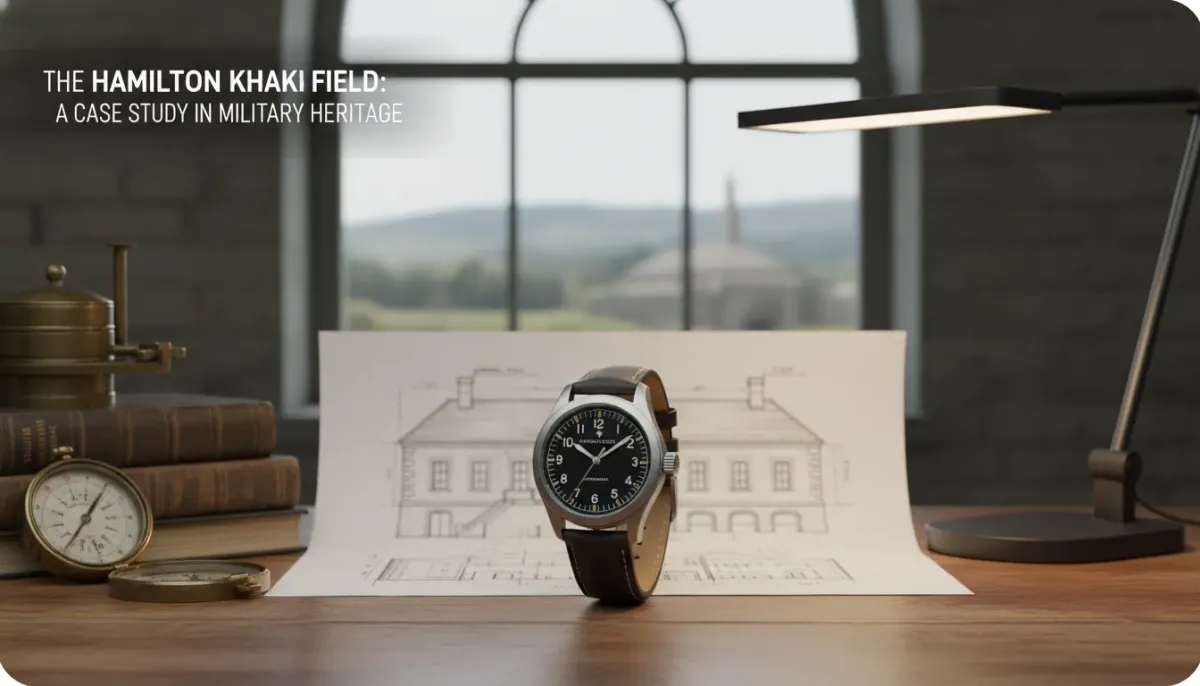
The Hamilton Khaki Field: A Case Study in Military Heritage
From the trenches of WWI to the silver screen, we explore how the Hamilton Khaki Field evolved from a tactical necessity into the ultimate everyday carry.
Feb 13, 2026 - Written by: Brahim amzil
Time didn’t matter much in the 19th century. Not down to the second, anyway. But when the world descended into the muddy, chaotic trenches of the First World War, time suddenly became the difference between a coordinated artillery barrage and friendly fire.
It was there, amidst the mustard gas and the roar of mortars, that the modern wristwatch was forged. It wasn’t born out of vanity or fashion. It was born out of survival. Soldiers, unable to fumble with pocket watches while holding a rifle, began soldering wire lugs onto their pocket watch cases and strapping them to their wrists. They called them “trench watches.”
Fast forward a century, and that utilitarian desperation has refined itself into one of the most iconic pieces of horology available today: the Hamilton Khaki Field.
But how did a piece of government-issued equipment, designed strictly to be cheap, legible, and disposable, transition into a staple of the modern gentleman’s wardrobe? Why do office workers and baristas strap on a watch designed for infantrymen?
The answer lies in a specific blend of American industrial history and Swiss precision. This isn’t just a review of a watch; it’s a case study in how military heritage dictates modern design language.
From Lancaster to the Front Lines
To understand the Khaki Field, you have to look at where it came from. Hamilton wasn’t always Swiss. Founded in Lancaster, Pennsylvania, in 1892, they started out building the “Watch of Railroad Accuracy.” They kept trains from colliding. That obsession with precision made them a natural partner for the US Military when Uncle Sam needed gear.
During World War II, Hamilton essentially shut down its consumer production lines. They went all in. We’re talking about producing over a million watches for the Allied forces. These weren’t luxury items. They were tools.
This era birthed the aesthetic we now recognize instantly.
The dial had to be black to prevent glare that might tip off a sniper. The numerals had to be white and bold for legibility in low light. The case had to be matte. And, crucially, it needed a “hacking” movement—a mechanism that stops the second hand when you pull the crown out.
Why? So a squad leader could say, “Synchronize watches,” and every soldier would be stepping off at the exact same second.
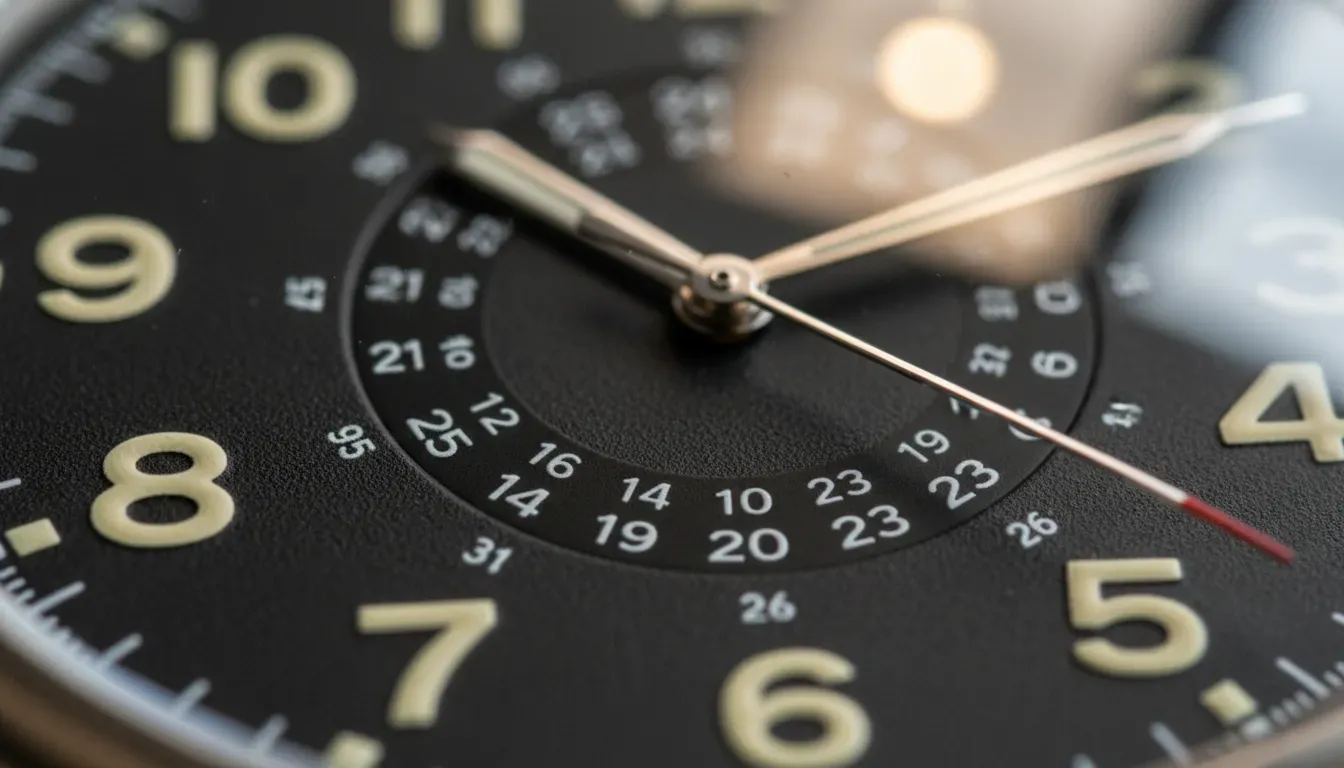
When you pick up a Hamilton Khaki Field Mechanical today, you are holding a direct descendant of those specs. It’s archaic in the best possible way. You have to wind it yourself. It’s small (38mm). It feels like it fell out of a time capsule from 1944.
The Vietnam Era: Defining the Specifications
If WWII was the birth, the Vietnam era was the adolescence where the field watch found its true identity. This is where the confusing alphanumeric soup of military specifications—like MIL-W-3818B and GG-W-113—comes into play.
Hamilton, along with brands like Benrus, was churning these out for GIs in the jungle. The design became sharper. The inner track of 24-hour markers became standard.
This is a detail that confuses a lot of civilian buyers. “Why are there numbers 13 through 24 on the inside?” simple: the military runs on a 24-hour clock. In the heat of operations, there is no “AM” or “PM.” There is only 0600 and 1800.
During the 1960s, the watch needed to withstand humidity, shocks, and the magnetic fields of modern machinery. The cases were often “parkerized”—a chemical process that protected the steel and gave it a dull, grey finish.
The modern Khaki Field captures this perfectly. It doesn’t try to be a dive watch. It doesn’t have a rotating bezel. It doesn’t have a chronograph function. It tells you the time, and it tells you now.
There is a purity in that single-minded purpose. In a world where our smartwatches buzz with emails, text messages, and heart rate warnings, looking at a Khaki Field is a quiet act of rebellion. It does one thing, and it does it perfectly.
The Hollywood Factor: The “Murph” and Beyond
You can’t talk about Hamilton without talking about movies. They call themselves the “Movie Brand,” and honestly, they’ve earned it. They’ve appeared in over 500 films. But one appearance changed the trajectory of the Khaki line forever.
Interstellar.
In Christopher Nolan’s sci-fi epic, the main character Cooper gives a watch to his daughter, Murph. The watch becomes a pivotal plot device—literally communicating across dimensions through Morse code on the second hand.
Fans went wild. They begged Hamilton to make it. For years, it was just a prop. Then, Hamilton listened. They released the Hamilton Khaki Field Murph.
The “Murph” is interesting because it bridges the gap. It has the military DNA—the cathedral hands, the beige lume that looks like aged radium, the rail-track minute circle—but it’s dressed up. It lacks the date window (a huge plus for purists) and carries a slightly more refined polish than the bead-blasted Mechanical version.
It showed that a field watch didn’t just have to be for guys who like camping and surplus gear. It could be emotional. It could be cinematic.
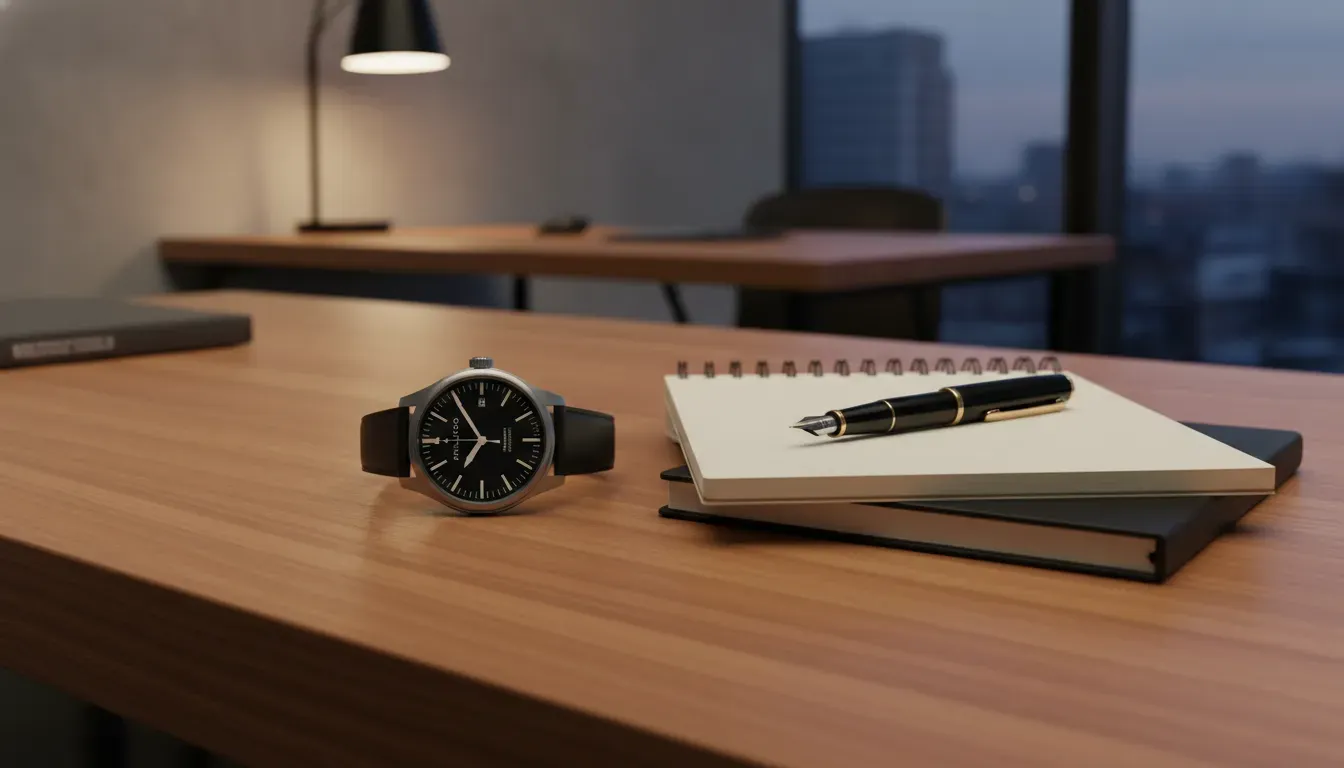
This transition is crucial. It’s similar to how the trench coat moved from the officers of WWI to Humphrey Bogart, and then to the high-fashion runways of Burberry. The utilitarian roots provide the authenticity, but the cultural adoption provides the cool factor.
Why It Works in a Modern Wardrobe
So, why does a watch designed for trench warfare work with a business casual outfit in 2026?
Versatility.
The Hamilton Khaki Field is the denim jeans of the watch world. Think about it. Jeans started as workwear for miners. Now, you wear them to dinner. The field watch follows the exact same trajectory.
Its dimensions are a massive part of this appeal. For years, the watch trend was “bigger is better.” We saw 45mm, 48mm dinner plates on wrists. The Khaki Field stayed true to its heritage sizing. The 38mm Mechanical is small by modern standards, but it fits the human wrist naturally. It doesn’t get caught on a shirt cuff. It doesn’t bang against doorframes.
If you are looking to build a wardrobe based on “Buy It For Life” principles, this watch is usually the first recommendation.
The Strap Monster
There is a term in the watch community: “Strap Monster.” It refers to a watch that looks good on literally anything you attach to it.
The Khaki Field is the king of this.
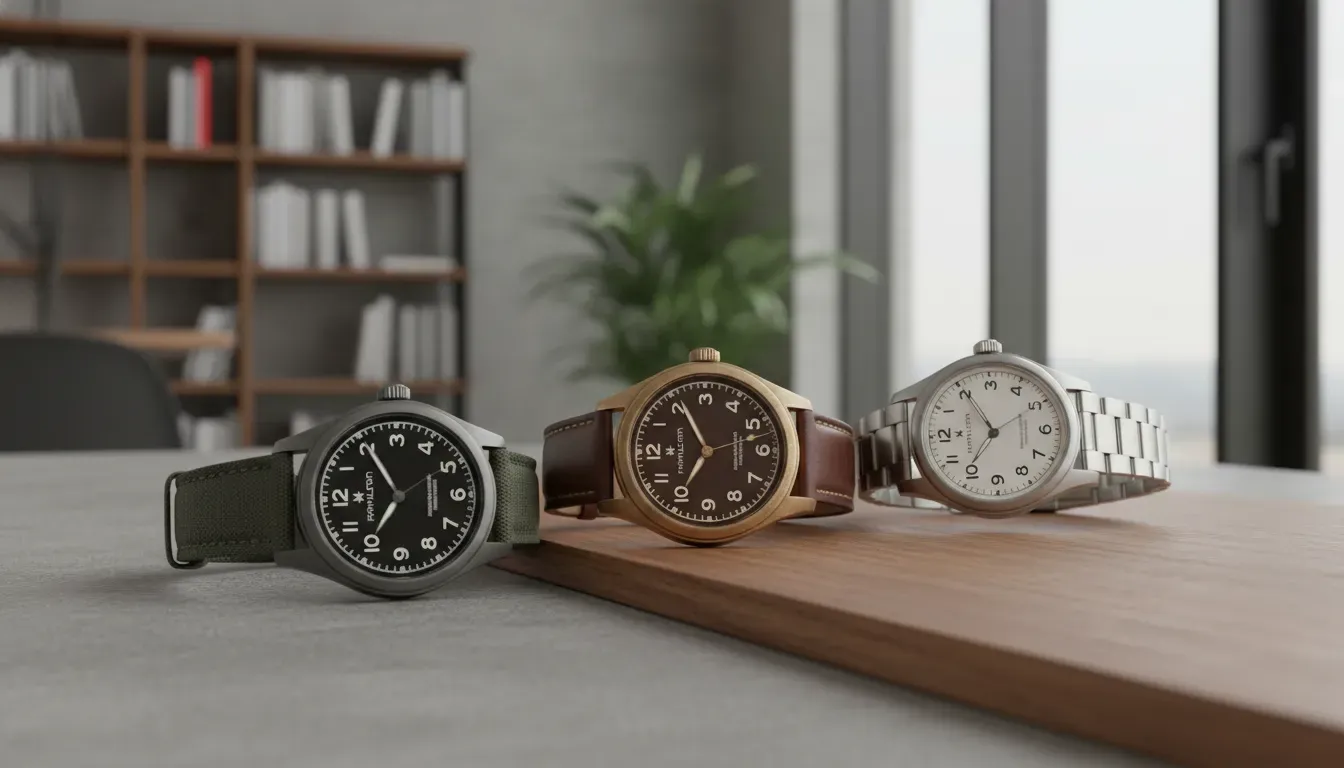
- On a NATO strap: It looks ready for a hike or a weekend working in the yard.
- On a leather strap: It suddenly looks smart enough for a casual office environment or a date night.
- On a steel bracelet: It becomes a rugged sports watch.
You can change the entire character of the watch in thirty seconds. For a minimalist trying to own fewer things, this is a superpower. You don’t need five watches; you need one watch and five straps. Check out our guide on watch accessories to see how strap choices impact your overall look.
Mechanical vs. Automatic: The Great Debate
When buying into this heritage, you face a choice. Do you go for the authentic hand-wound experience, or do you opt for modern convenience?
The Khaki Field Mechanical is the purist’s choice. You have to wind it every day or two. There is a physical connection with the machine. It uses the H-50 movement, which has an impressive 80-hour power reserve. This means you can take it off on Friday, put it on Monday, and it’s still ticking.
However, some people just want to put a watch on and forget it. For them, the Khaki Field Automatic (often called the Khaki King or just the Auto) is the answer.
The Hamilton Khaki Field Automatic adds a rotor that winds the watch as you move your arm. It usually adds a date window, sometimes a day of the week display. It’s slightly thicker, slightly dressier, often featuring a polished bezel rather than the all-matte finish of the mechanical.
Neither is wrong. It depends on your lifestyle. Do you want the ritual of winding, or the ease of automation?
Material Innovation: Titanium and Bronze
Hamilton hasn’t just rested on the steel designs of the 1960s. Recently, they’ve pushed the “field” concept into modern materials.
Titanium versions of the Khaki Field have become incredibly popular. Why titanium? It’s lightweight and hypoallergenic. A steel watch reminds you it’s there; a titanium watch disappears until you need it. For active users—hikers, climbers, people actually using the watch in the “field”—titanium is a functional upgrade.
Then there is bronze.
Bronze is a living material. It oxidizes. When you buy a bronze Khaki Field, it’s shiny and gold-like. Give it three months of wear, exposure to air, sweat, and perhaps a dip in the ocean, and it develops a patina. It turns brown, green, and slate grey. No two bronze watches look the same after a year.
This plays perfectly into the “Human-First” philosophy of style. The watch becomes a record of your life. That scratch from fixing the car, that discoloration from a beach trip—it’s all etched into the metal.
The Value Proposition
We have to talk about money. In the world of Swiss watches, prices have gone insane. Rolex, Omega, IWC—their entry-level prices move further out of reach every year.
Hamilton occupies a rare sweet spot. They offer genuine Swiss heritage, ETA-based powertrains (modified exclusively for them), and sapphire crystals, usually for under $600 to $1,000 depending on the model.
It is often the first “real” watch a man buys. It’s the gateway drug. But unlike other entry-level items that you discard when you upgrade, the Khaki Field usually stays in the collection. Even guys with $10,000 Submariners still wear their Hamiltons. It earns respect because it isn’t trying to be luxury; it’s trying to be quality.
Conclusion: A Tool for Life
The transition of the field watch from the muddy trenches of Europe to the wrists of modern civilians isn’t an accident. It happened because good design is timeless.
The Hamilton Khaki Field doesn’t have an app. It doesn’t track your steps. It doesn’t notify you when your Uber has arrived. It marks the passage of time, reliably, legibly, and durably.
In an age of planned obsolescence, where our phones slow down after two years and our clothes fall apart after ten washes, owning something built to military specifications feels different. It feels permanent.
Whether you choose the hand-wound mechanical for that connection to history, or the “Murph” for the cinematic flair, you aren’t just buying a watch. You’re buying a case study in survival. You’re wearing a piece of engineering that proved itself when the stakes were life and death.
And honestly? It just looks damn good with a t-shirt.