The Impossible Ask: Buying a Rolex Daytona at Retail
Is buying a Rolex Daytona at retail possible? We break down the waiting lists, purchase history requirements, and the reality of authorized dealer politics.
The Impossible Ask: Buying a Rolex Daytona at Retail
Buying a stainless steel Rolex Daytona at retail price is virtually impossible for a first-time customer. Authorized Dealers (ADs) receive exceedingly limited stock—often fewer than two or three pieces per year—and these are allocated strictly to “VIP” clients with substantial purchase histories. To be considered for a Daytona at its MSRP, you typically need to have spent tens of thousands of dollars on other watches or jewelry with that specific retailer, effectively building a “relationship” that unlocks access to their most coveted models. If you walk in off the street with no prior history, the answer will almost certainly be a polite but firm “no.”
The Unicorn of the Watch World
Let’s be honest about what we are dealing with here. The Rolex Cosmograph Daytona, specifically the stainless steel reference (currently the 126500LN), isn’t just a watch. It is a currency. It is a cultural phenomenon that transcends horology.
When you ask an AD for a Daytona, you aren’t asking to buy a product. You are asking them to hand you anywhere from $15,000 to $20,000 in free equity. With the retail price hovering around $15,000 and the grey market value sitting nearly double that (depending on market fluctuations), the dealer knows exactly what they are holding. Why would they give that “winning lottery ticket” to a stranger?
They wouldn’t. And they don’t.
This creates a dynamic that frustrates collectors and fuels the fire of desire. It’s basic economics mixed with high-stakes retail politics. While other brands are experimenting with the lightweight benefits of titanium vs. stainless steel to attract buyers, Rolex sticks to its 904L Oystersteel and simply restricts the supply. The scarcity is the marketing.
Understanding “The List”
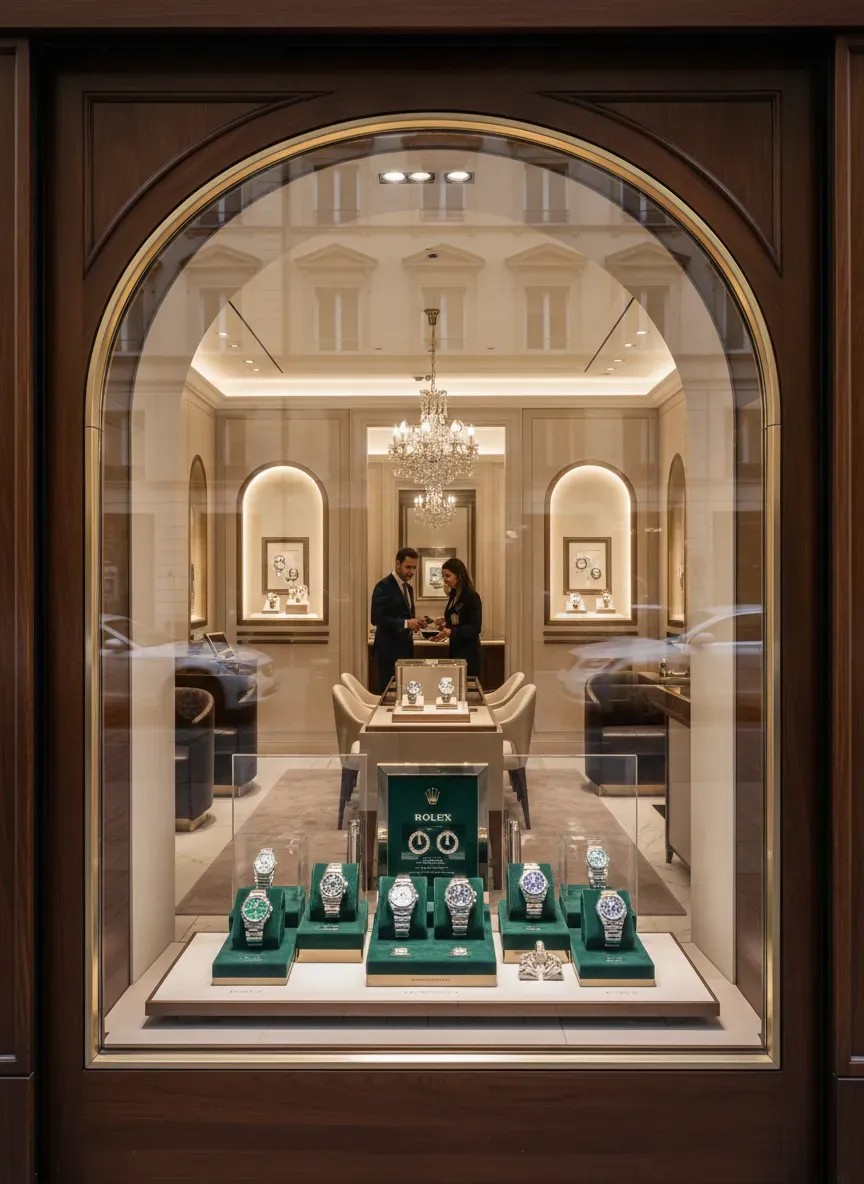
You will hear people talk about “The List.” Let’s shatter a myth right now: for the Daytona, there is no chronological list.
If you envision a ledger where your name moves up one spot every time a watch is delivered, you are mistaken. The “list” is actually a pool of qualified candidates. When a Daytona arrives in the safe, the store manager and sales associates review their client portfolio. They look for specific criteria:
- Retention: Will this client flip the watch immediately for a profit? (If yes, you are blacklisted).
- Spend History: Has this client bought high-margin items like diamonds, gold jewelry, or less desirable watch models?
- Milestones: Is the client celebrating something significant?
It is a meritocracy based on spending. You are competing against the guy who just bought his wife a diamond necklace and himself a gold Day-Date.
The Cost of Entry: Building the Relationship
So, you still want to play the game? You need a strategy. You cannot brute force your way into a Daytona allocation unless you are willing to overpay on the secondary market. If you are determined to get one with your name on the warranty card at retail price, you have to pay your dues.
The “Stepping Stone” Strategy
You need to buy what the dealer needs to sell. This is the unwritten contract of the luxury watch world. You might walk in wanting the chronograph, but you’ll likely walk out with a Datejust or perhaps a Tudor.
This isn’t necessarily a bad thing. Building a collection is a journey. Before you jump to the Daytona, you might find incredible value in other areas. For example, while you wait, looking into the market for pre-owned Rolex Air-Kings can keep your itch scratched without requiring a five-figure spend at the boutique.
However, be careful not to buy things you hate just to get what you love. That is a quick way to resent the hobby. If you genuinely appreciate horology, use this time to explore other complications. You might find yourself fascinated by how complications like the GMT and Moonphase work, which could lead you to purchase a complicated dress watch that the AD is eager to move. That purchase puts a gold star next to your name.
To keep your current collection in pristine condition while you navigate these politics, you should be investing in proper storage. A high-quality winder is essential for automatic movements.
The Psychology of the Sales Associate
Your Sales Associate (SA) is the gatekeeper. Treat them with respect, but don’t be a sycophant. They deal with rude, entitled millionaires all day long. Being a genuine enthusiast who is polite, patient, and knowledgeable goes a long way.
Visit the store periodically. Not to nag, but to chat. Wear your other watches. Show that you are a collector, not a flipper. If you have a specific milestone coming up—a wedding, a 40th birthday, a graduation—make that known. ADs love to tie a “special” allocation to a life event because it reduces the likelihood of you selling the watch.
The “Bundle” Deal
Sometimes, the quiet part is said out loud. Some dealers might explicitly hint that if you buy a specific slow-moving piece (often a precious metal watch or a ladies’ jewelry piece), the Daytona can be “unlocked.” It’s effectively a bundle deal. You are paying a premium, just not on the Daytona itself. You are paying the opportunity cost of buying another item at full retail that might depreciate.
The Technical Magnetism
Why go through all this trouble? Is the watch actually that good?
Objectively, yes. The modern Daytona runs on the Calibre 4130 (or the newer 4131), a vertical clutch chronograph movement that is robust, accurate, and serviceable. It wears beautifully on the wrist. The dimensions are nearly perfect for a sports chronograph.
But let’s be real—there are better chronographs out there for the money. The Zenith Chronomaster Sport, for instance, has a more technically impressive movement. The Omega Speedmaster has a richer history.
If the racing heritage doesn’t stick for you, or if the wait becomes unbearable, you might find better availability and utility looking at the top 5 pilot watches. These offer a similar rugged utility without the years-long waiting game.
The Grey Market Alternative
There is one way to skip the line: Money.
The “Grey Market” refers to trusted secondary dealers who sell unworn or pre-owned watches. You can have a Daytona on your wrist tomorrow if you wire the money today. The catch? You will pay a premium ranging from 50% to 100% over the retail price.
For many high-net-worth individuals, this is the preferred route. Time is money. Why spend two years courting a sales associate and buying $30,000 of jewelry you don’t want, just to save $15,000 on the watch? Mathematically, going grey often makes more sense than playing the AD game.
If you do go this route, or if you eventually secure your grail from an AD, protection is paramount. You aren’t just tossing this in a drawer.
Case Elegance Solid Wood Watch Box
When to Walk Away
There is a point where the pursuit becomes undignified. If a dealer treats you poorly, ignores you, or constantly moves the goalposts, walk away. No watch is worth your self-respect.
The luxury market is softening in some areas, but the Daytona remains resilient. However, the days of ADs acting like gods are slowly numbered as inventory levels in other sectors normalize.
If you love the look but hate the game, look at the alternatives. The world of horology is vast. Don’t let the Crown blind you to the incredible engineering coming out of other houses like Jaeger-LeCoultre, Glashütte Original, or Grand Seiko.
The Long Game
If you are dead set on retail, buckle up. It is a marathon.
- Pick one Authorized Dealer and stick to them. Spreading your spend across five stores gets you nowhere. You need to be a “big fish” in one pond, not a minnow in five.
- Be specific. Don’t ask for “any sport model.” Tell them you want the Stainless Steel Daytona with the white dial (Panda) and explain why.
- Be patient. We are talking years, not months.
While you wait, educate yourself. Read about the history of the brand. Understanding the nuance of what you are buying makes the eventual call that much sweeter.

Is It Worth It?
When you finally get the call—and if you play the game right, you eventually will—the feeling is electric. Walking into the store, skipping the display cases, and being led to the private room is a rush.
Peeling the stickers off (or watching the SA do it, as is policy now) and sizing the bracelet makes the years of patience evaporate. You look down at your wrist and realize you are wearing an icon.
Buying a Rolex Daytona at retail is an impossible ask for most. But for the persistent, the strategic, and the patient, it is a trophy that signifies more than just the time. It signifies that you beat the game.