Complications Explained: GMT, Moonphase, and Date
Master the mechanics of horology. We break down the utility of GMTs, the romance of the Moonphase, and the essential Date complication in plain English.
Complications Explained: GMT, Moonphase, and Date
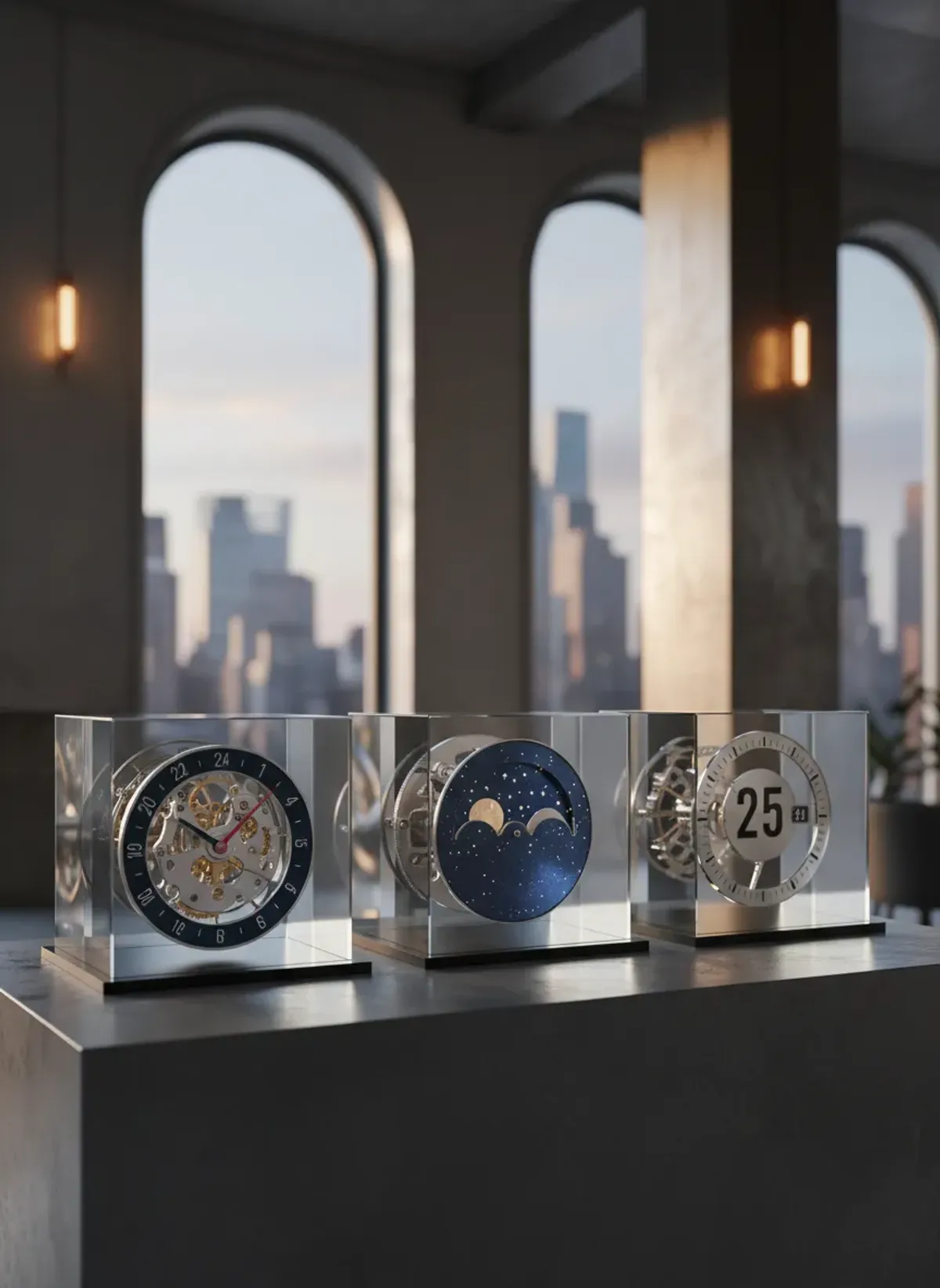
A watch complication is any feature on a mechanical timepiece that does something other than display hours, minutes, and seconds. The Date complication is the most practical, displaying the day of the month through an aperture or sub-dial. The GMT (Greenwich Mean Time) function utilizes a fourth hand to track a second time zone, making it the definitive tool for travelers. Finally, the Moonphase tracks the 29.5-day lunar cycle, offering a visual representation of the moon’s current phase—a complication prized more for its artistic beauty and engineering prowess than modern utility.
More Than Just Telling Time
There is something inherently fascinating about a tiny machine strapped to your wrist that does math using nothing but springs and gears.
When you strip away the branding and the marketing fluff, a watch is an engine. And like any engine, you can supercharge it. In horology, these superchargers are called “complications.” Don’t let the name scare you off. While the engineering inside is indeed complicated, the result on the dial is usually about solving a problem.
Whether you are trying to coordinate a Zoom call with Tokyo, remembering your anniversary, or just wondering if the tide is high, there is a complication for that. Today, we are stripping down three of the most popular heavy hitters in the industry: the utilitarian Date, the jet-setting GMT, and the poetic Moonphase.
The Date: The Essential Daily Driver
Let’s start with the feature you likely check more often than the time itself. The Date complication is the bread and butter of the watch world. It transformed the wristwatch from a piece of jewelry into an essential daily tool.
Historically, this wasn’t always standard. It wasn’t until Rolex introduced the Datejust in 1945 that we saw the date change automatically at midnight. Before that, you were largely on your own.
How It Works
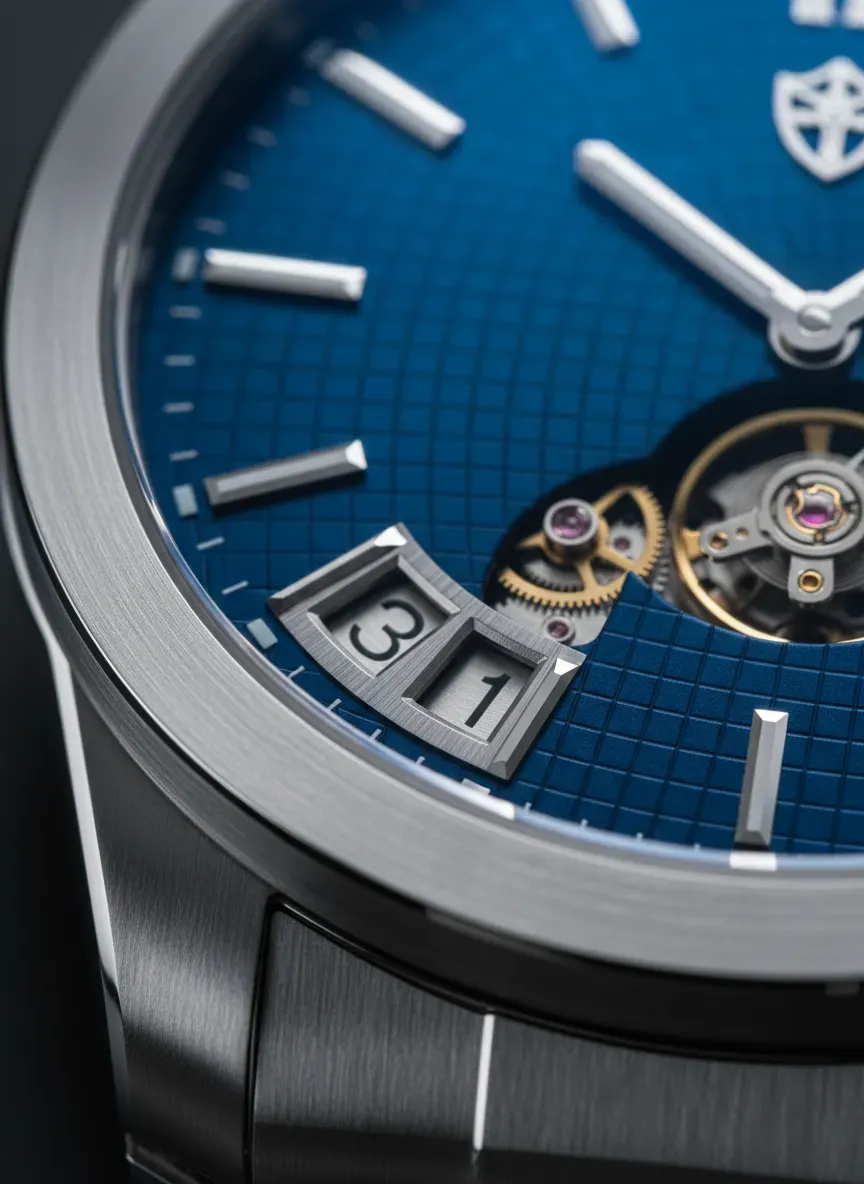
In its simplest form, the date mechanism consists of a wheel with numbers 1 through 31 printed on it. This wheel sits just under the dial. Driven by the movement’s geartrain, a “finger” or cam builds up tension and pushes this wheel forward once every 24 hours.
Click.
That distinct snap at midnight (or slowly dragging over from 11 PM to 2 AM on cheaper movements) is the heartbeat of the daily wearer.
Variations on a Theme
Not all date windows are created equal. You’ll run into a few distinct styles as you hunt for your next piece:
- The Window Date: A simple square cut out of the dial, usually at 3 or 6 o’clock.
- The Pointer Date: A central hand points to numbers printed on the outer rim of the dial. It’s vintage, classy, and doesn’t break the dial’s symmetry.
- The Big Date (Grande Date): Two separate disks work together to display the date in a much larger format. One disk handles the tens (0-3), the other handles the units (0-9).
If you are just dipping your toes into horology, you don’t need to spend five figures to get a reliable calendar on your wrist. In fact, many collectors start their journey exploring our list of top entry-level luxury watches, almost all of which feature robust date movements that can outlast their owners.
The “Danger Zone”
Here is a pro-tip nobody tells you until you break your first watch: Never change the date manually between 9 PM and 3 AM.
During these hours, the gears are already engaged to perform the automatic date change. Forcing the quick-set mechanism during this window is like shifting your car into reverse while driving on the highway. You will hear a crunch, and it will be expensive.
The GMT: The Jet-Setter’s Best Friend
If the Date watch is the daily commuter, the GMT is the trans-Atlantic pilot.
The GMT (Greenwich Mean Time) complication was born out of necessity in the 1950s. Pan Am Airlines approached Rolex with a problem: their pilots were flying across multiple time zones rapidly and needed a way to track home time and local time simultaneously.
The result was the GMT-Master, and it changed the sports watch landscape forever.
The Anatomy of a GMT
A standard watch has three hands. A GMT has four. That fourth hand—often colored red or orange—rotates around the dial once every 24 hours, rather than every 12. It points to a 24-hour scale, usually located on the bezel.
By setting this 24-hour hand to GMT (or your home time) and the standard hour hand to your local time, you instantly know what time it is in two places at once. If the bezel rotates, you can even track a third time zone. It is the ultimate tool for the business traveler or the digital nomad.
For a robust, affordable entry into the world of travel watches, look at the Seiko 5 Sports SSK001 Automatic GMT. It offers that classic “caller” GMT functionality without the luxury markup.
Flyer vs. Caller: The Great Debate
Not all GMTs function the same way, and this distinction drives collectors crazy.
- True (Traveler/Flyer) GMT: When you pull the crown, the local 12-hour hand jumps in one-hour increments. This is ideal for travelers because you can change time zones without stopping the watch or messing up your 24-hour home time. (Think Rolex GMT-Master II).
- Office (Caller) GMT: When you pull the crown, the 24-hour hand jumps. This is better if you stay in one place but need to track time for calls abroad.
Because of the desirability of “True” GMT movements, this category of watch is rife with replicas. It is notoriously difficult to distinguish a high-end clone from the real deal without opening the case back. If you are looking at the second-hand market for a luxury traveler’s watch, you need to educate yourself on how to spot a fake luxury watch before dropping thousands of dollars.

The Moonphase: Uselessly Beautiful
Let’s be honest. Unless you are a werewolf, a biodynamic farmer, or a sailor navigating purely by tidal charts, you probably don’t need to know the phase of the moon.
But luxury isn’t about need. It’s about emotion. And the Moonphase is pure romance.
Engineering Art
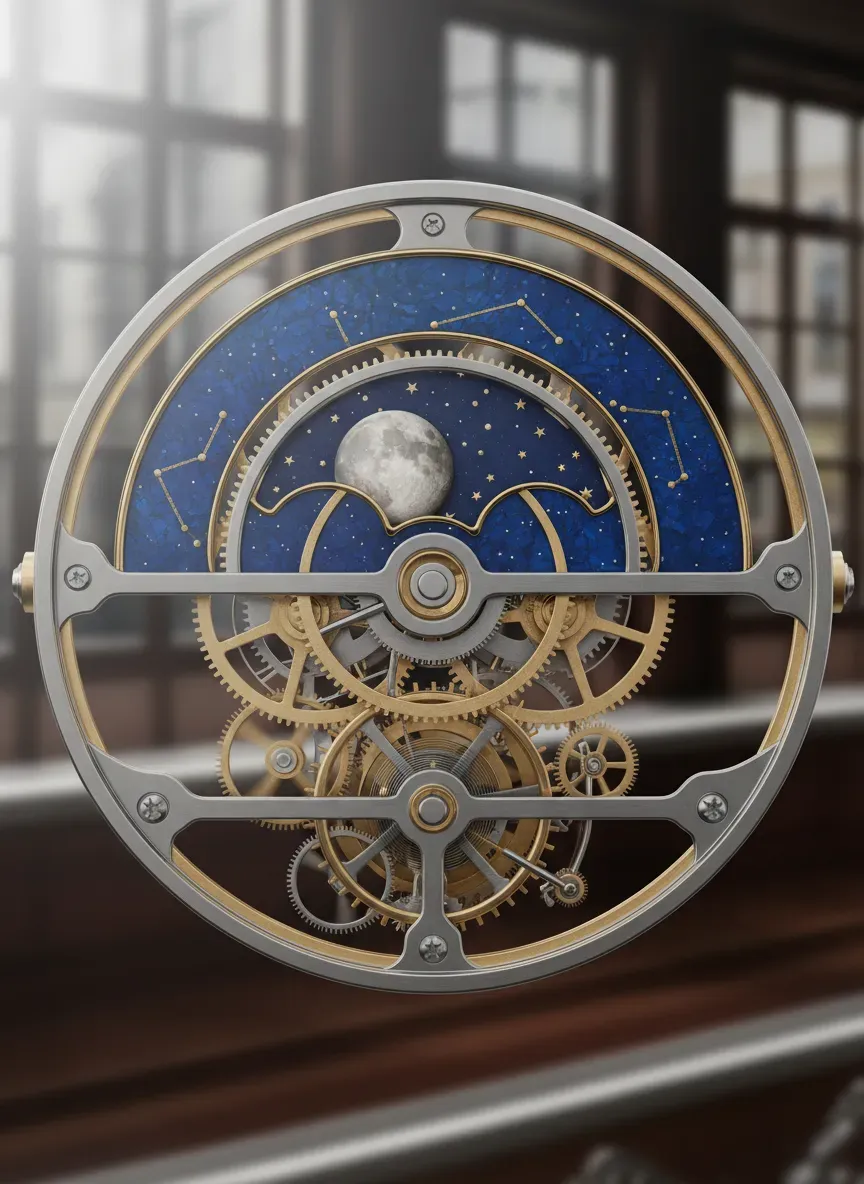
The Moonphase complication tracks the lunar cycle, which lasts approximately 29.5 days. The watch displays the current phase of the moon—waxing, waning, full, or new—usually through a semicircular aperture where a painted disc rotates beneath the dial.
The mechanism usually involves a gear with 59 teeth. Why 59? Because two lunar cycles (29.5 x 2) equal 59 days. The disc has two moons painted on it. As the gear advances one tooth every 24 hours, the moon cycle completes every 29.5 days.
Why We Love It
It connects us to the cosmos. In an era of digital precision, looking down and seeing a miniature gold moon rising amidst a field of stars is a grounding experience. It reminds us that time isn’t just numbers on a screen; it’s the movement of celestial bodies.
Moonphase watches are typically dressier, often paired with leather straps and elegant cases. If you want to add this touch of class to your wardrobe without breaking the bank, the Orient Bambino Version 2 series offers incredible value and aesthetics that punch way above their weight class.
However, accuracy varies. A standard 59-tooth moonphase will be off by one day every two and a half years. High-end astronomical moonphases? They can remain accurate for over 1,000 years without adjustment. That is the kind of over-engineering we live for.
The Cost of Complexity
Adding complications does two things to a watch: it increases the price, and it increases the service cost.
A time-only watch is relatively easy to service. A chronograph with a triple calendar and a moonphase is a nightmare for a watchmaker. It has hundreds of tiny parts, springs, and levers packed into a case the size of a hockey puck.
When you buy a complicated watch, you are entering a relationship with it. It requires movement. If you leave a moonphase or a triple calendar in a drawer for a month, resetting it is a chore. Many collectors invest in WOLF Watch Winders to keep the oils moving and the calendars current when the watch isn’t on the wrist.
Investment Perspective
Do complications make a watch a better investment? Generally, yes, but it depends on the brand. A Patek Philippe Perpetual Calendar is “blue chip” stock. A generic fashion watch with busy sub-dials is not.
If you are looking to park money in horology, you need to understand which complications are actually rare and desirable versus which ones are mass-produced gimmicks. We cover this distinction in depth in our investment guide to entry-level watches, helping you decide if you should pay the premium for that extra functionality.
Which One Suits You?
Your choice of complication should reflect your lifestyle—or the lifestyle you aspire to.
- The Pragmatist: Stick to the Date. It’s clean, useful, and robust. You don’t want to fiddle with settings; you just want to know if today is the 14th or the 15th.
- The Explorer: Go for the GMT. Even if you aren’t flying internationally every week, having that 24-hour hand is a great way to track a partner abroad or just keep yourself oriented. Plus, the bi-color bezels (Pepsi, Batman, Coke) look fantastic.
- The Dreamer: The Moonphase is for you. It’s a conversation starter. It’s a piece of art. It says you appreciate the mechanics of the universe, not just the minutes of the hour.
At the end of the day, a mechanical watch is an anachronism. We have phones that tell time more accurately than a $50,000 Swiss tourbillon ever could. But we don’t wear them for accuracy. We wear them for the story. Whether that story is about travel, astronomy, or just getting through the work week, there is a complication written just for you.